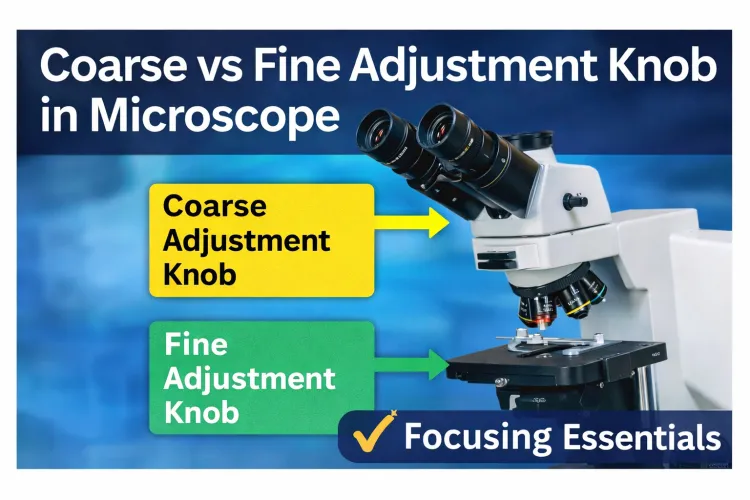
What Is a Coarse Adjustment Knob?
The coarse adjustment knob is the primary focusing control used at the initial stage of microscope observation. It is designed to move the stage—or, in some microscope designs, the objective lenses—up and down in relatively large increments. This movement allows the user to quickly bring the specimen into approximate focus.

Typically, the coarse adjustment knob is the larger of the two focusing knobs and is positioned on both sides of the microscope arm for easy access. Its size and design reflect its function: rapid, broad focusing rather than precise image refinement.
Coarse Adjustment Microscope Function
The coarse adjustment microscope function is to perform large vertical movements of the stage or objective assembly. This function is especially useful when starting an observation session. When a slide is placed on the stage, the specimen is often far from the focal plane. By turning the coarse adjustment knob, the user can quickly move the stage upward or downward until the specimen comes into view. This process saves time and prevents unnecessary strain caused by searching blindly for focus.
Key points about the coarse adjustment microscope function include:
-
It is mainly used with low-power objectives, such as 4× or 10×.
-
It allows fast focusing but lacks precision.
-
It should be used carefully to avoid contact between the objective lens and the slide.
What Is a Fine Adjustment Knob in a Microscope?
The fine adjustment knob is designed for precision focusing. Unlike the coarse adjustment knob, it moves the stage or objective in extremely small increments, often at the micron level. This allows for careful refinement of the image once the specimen is roughly in focus.

In simple terms, the fine adjustment knob helps turn a “nearly clear” image into a sharp, detailed one. It is especially important when observing fine structures such as cellular components, microorganisms, or tissue details.
Coaxial Coarse and Fine Adjustment Knobs in Modern Microscopes

In many modern laboratory microscopes, the coarse adjustment knob and fine adjustment knob are integrated into a single coaxial control system. This design places both knobs concentrically on the same axis, allowing smooth transition from rapid initial focusing to precise fine focusing. Coaxial focusing improves handling accuracy, reduces operator fatigue, and provides better control during high-magnification observation.
What Does the Fine Adjustment Knob Do on a Microscope?
A common question among beginners is: what does the fine adjustment knob do on a microscope? The answer lies in image refinement.
The fine adjustment knob slightly adjusts the distance between the objective lens and the specimen, allowing the user to sharpen the image without disturbing its position. This subtle movement improves contrast, clarity, and depth of field.
By using the fine adjustment knob, the observer can:
-
Bring fine details into sharp focus
-
Avoid sudden movements that could disrupt the specimen
-
Focus safely at higher magnifications
Because it moves the stage very slowly, the fine adjustment knob is far safer for delicate slides and high-power objectives than the coarse adjustment knob.
Fine Adjustment Knob Microscope Function
The fine adjustment knob microscope function is to provide precise control over the focal plane. This is particularly important when using objectives with high numerical apertures, where even slight changes in focus can significantly affect image clarity. In practice, the fine adjustment knob allows the user to “scan” through different layers of the specimen. This is useful when observing thick samples or when trying to focus on specific structures at different depths.
Fine Focus Microscope Function
The fine focus microscope function goes beyond simple sharpening. It enables controlled, incremental adjustments that are necessary for detailed analysis.
Fine focus is particularly important in the following situations:
Unlike coarse focus, fine focus maintains the stability of the image. This stability is critical in professional microscopy, where even slight vibrations or sudden movements can distort the observed structures.
Difference Between Coarse and Fine Adjustment Knob
Although both knobs are used for focusing, their functions are clearly distinct. Understanding the difference helps users apply each control correctly and safely.
Comparison Table
| Aspect |
Coarse Adjustment Knob |
Fine Adjustment Knob |
| Movement size |
Large, rapid movement |
Very small, precise movement |
| Purpose |
Initial focusing |
Image refinement |
| Speed |
Fast |
Slow and controlled |
| Precision |
Low |
High |
| Typical use |
Low magnification |
Medium to high magnification |
| Risk level |
Higher if misused |
Very low |
In practical terms, the coarse adjustment knob gets you close to focus, while the fine adjustment knob brings the image into perfect clarity.
Step-by-Step Guide to Focusing a Microscope Correctly
Proper focusing develops with practice, but following a structured method helps prevent common mistakes:
-
Place the slide securely on the stage and center the specimen under the objective lens. Start with the lowest power objective selected.
-
While viewing from the side, use the coarse adjustment knob to raise the stage close to the objective lens, ensuring the slide is not damaged.
-
Look through the eyepiece and slowly lower the stage using the coarse adjustment knob until the specimen becomes visible.
-
Once visible, use the fine adjustment knob to sharpen the image and achieve clear focus.
-
When switching to higher magnifications, use only the fine adjustment knob to maintain focus safely and accurately.
Common Mistakes While Using Microscope Adjustment Knobs
Many focusing issues occur due to simple but avoidable errors, such as:
-
Using the coarse adjustment knob at high magnification, which can cause the objective lens to strike the slide and result in damage
-
Over-tightening the focusing knobs, placing unnecessary strain on internal mechanisms and reducing the microscope’s lifespan
-
Rushing the focusing process or ignoring illumination and condenser adjustments, leading to poor image quality
Careful handling and proper technique are essential for safe and accurate microscopy.
Why Understanding Adjustment Knob Functions Is Important
Understanding the functions of coarse and fine adjustment knobs is important because it:
-
Improves image clarity for accurate observation of microscopic structures
-
Helps prevent damage to delicate lenses, slides, and focusing mechanisms
-
Builds confidence and correct laboratory habits in students and professionals
Proper focusing techniques ensure reliable results and support effective learning and professional microscopy work in educational and research environments.
Frequently Asked Questions (FAQ)
Can the coarse adjustment knob be used at high magnification?
It is generally not recommended. At high magnification, the working distance is very small, and using the coarse adjustment knob can damage the slide or objective lens.
Why is the fine adjustment knob more precise?
The fine adjustment knob moves the stage or objective in very small increments, allowing accurate control of focus without disturbing the specimen’s position.
What happens if a microscope is not focused correctly?
Incorrect focusing can blur details, reduce contrast, strain the eyes, and lead to misinterpretation of the specimen.
Ending Notes
The coarse adjustment knob and fine adjustment knob are key parts of a microscope’s focusing system, each with a clear purpose. The coarse knob helps bring the specimen into quick, rough focus, while the fine knob sharpens details safely and accurately. Knowing the coarse adjustment microscope function and fine focus microscope function is essential for clear viewing, slide safety, and confident microscope use in both learning and laboratory work.