
Phase Contrast Microscope for Research Laboratories: Applications & Selection Guide
A phase contrast microscope converts subtle differences in a specimen's refractive index into visible optical contrast, without staining. This makes transparent, low-contrast specimens such as living cells easier to observe in detail. In research laboratories, this is especially useful when a sample cannot be stained or fixed without affecting normal cell activity.
This guide covers how a phase contrast microscope works, where it is used in research, and what to check before selecting one.
What Is a Phase Contrast Microscope? 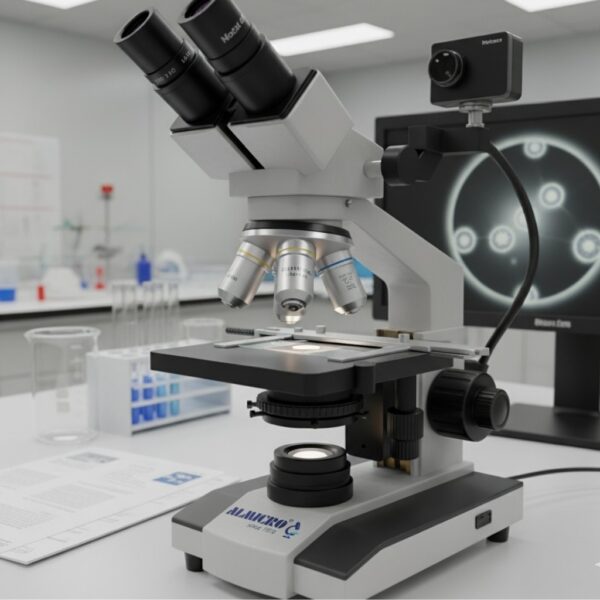
A phase contrast microscope turns differences in refractive index and thickness within a specimen into visible differences in brightness. This creates optical contrast in otherwise transparent material.
Bright-field microscopy depends mainly on natural color or density differences, so unstained samples can be difficult to see. Phase contrast microscopy detects changes in the phase of light as it passes through a specimen and converts those changes into visible contrast.
Because staining is often unnecessary, researchers can observe living cells and study changes in cell morphology without fixing or staining the sample. This makes phase contrast microscopy useful in cell biology and microbiology laboratories.
How Does a Phase Contrast Microscope Work?
Light and Specimen Interaction
Light passes through the specimen and its surrounding medium at different speeds depending on their refractive index and thickness. This creates a phase shift between light passing through the specimen and light passing around it.
Phase Contrast Components
Three main components make phase contrast possible:
- Annular diaphragm: Located below the condenser, it shapes the illuminating light into a ring.
- Phase contrast objective: Contains a phase plate designed for phase contrast imaging.
- Phase plate: Changes the phase and intensity of light passing through the specimen relative to the background light.
Applications of Phase Contrast Microscopes in Research
Phase contrast microscope applications cover several areas of biological and laboratory research.
Cell Biology
Phase contrast microscopy can be used to observe living cells, examine cell morphology, and monitor changes in cell growth and structure over time.
Microbiology
It is useful for observing microorganisms and other unstained biological samples where sample preservation and quick observation are important.
Pharmaceutical and Life Science Research
Researchers can use phase contrast microscopy to monitor cell cultures and observe changes in biological samples during research and compound testing.
Educational and Laboratory Research
Phase contrast microscopes are also useful for laboratory demonstrations and routine observations of transparent specimens that require better contrast.
Phase Contrast vs Bright-Field Microscopy
| Feature | Phase Contrast | Bright Field |
|---|---|---|
| Low-contrast specimens | Well suited | Can be difficult to observe |
| Living cells | Useful for observation | May require additional contrast |
| Staining | Often not required | Frequently used for better contrast |
| Common applications | Cell and biological research | General microscopy |
The right microscopy technique depends on the specimen and the research objective.
How to Choose a Phase Contrast Microscope
- Optical quality: Image clarity and contrast depend on the quality of the objectives and other optical components.
- Phase contrast objectives: Check that the objective magnifications match your application and are compatible with the phase contrast system.
- Condenser and phase components: The phase condenser, annular diaphragm, and phase components should be properly matched and aligned.
- Illumination: Stable and uniform illumination helps provide consistent images. LED illumination can be a practical choice for routine laboratory work.
- Camera compatibility: If images need to be recorded or shared, check whether the microscope supports a suitable digital camera.
- Service and support: Consider warranty, spare parts, technical assistance, and after-sales service before making a purchase.
Phase Contrast Microscope in India: What Should You Check?
Buyers evaluating a phase contrast microscope in India should consider application suitability, optical specifications, product configuration, accessories, spare parts, warranty, and technical support.
Laboratories can compare manufacturers based on optical quality, product specifications, application support, and after-sales service. ALMICRO provides microscope solutions for laboratory and research applications, allowing buyers to discuss their requirements before selecting a suitable configuration.
Phase Contrast Microscope Manufacturer: What to Look For
When evaluating a phase contrast microscope manufacturer, consider manufacturing experience, optical quality, product documentation, technical support, and spare parts availability.
Buyers should look beyond price and consider product quality, technical support, and long-term service capability. ALMICRO, established in 1978 and offering a range of microscope models, is one manufacturer buyers can consider when evaluating their options.
Advantages and Limitations of Phase Contrast Microscopy
Advantages
- Provides good contrast for transparent specimens.
- Useful for observing living cells.
- Often does not require staining.
- Useful for studying cell morphology.
Limitations
- Halo artifacts can appear around specimen edges.
- Thick specimens can be difficult to interpret.
- Proper phase alignment is important for good image quality.
- It is not the best technique for every type of specimen or application.
FAQs
What is a phase contrast microscope used for?
A phase contrast microscope is used to observe transparent and low-contrast specimens such as living cells. It is commonly used in cell biology and microbiology research.
Can phase contrast microscopy be used for living cells?
Yes. Since staining is usually not required, phase contrast microscopy is well suited for observing living cells without disrupting them with fixation or staining.
Does phase contrast microscopy require staining?
Usually, no. Phase contrast microscopy creates visible contrast from differences in the optical properties of the specimen.
What is the difference between phase contrast and bright-field microscopy?
Phase contrast microscopy converts invisible phase differences into visible contrast, while bright-field microscopy mainly relies on differences in color, density, or absorption to make a specimen visible.
How do I choose a phase contrast microscope?
Check the optical quality, phase contrast objectives, condenser and phase components, illumination, camera compatibility, and after-sales support.
What should I look for in a phase contrast microscope manufacturer?
Look for manufacturing experience, consistent optical quality, clear documentation, technical support, spare parts availability, and reliable after-sales service.
Final Thoughts
Phase contrast microscopy is well suited to low-contrast and transparent specimens, with applications across cell biology, microbiology, and related research areas. Selecting the right microscope depends on the optical system, phase contrast components, application requirements, imaging needs, and manufacturer support.
If you are looking for a phase contrast microscope for research or laboratory applications, contact ALMICRO to discuss your requirements and a suitable configuration.