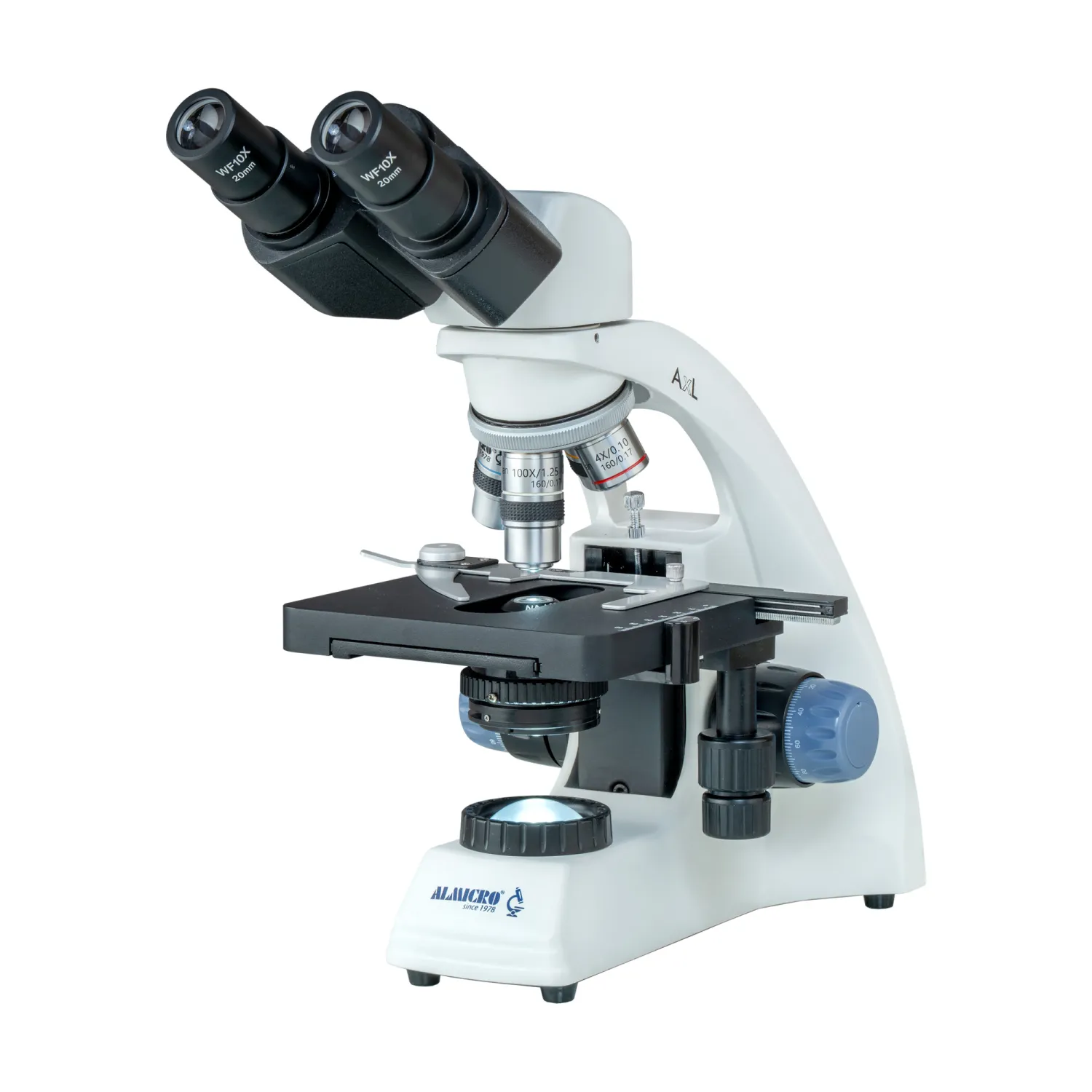

BINOCULAR MICROSCOPE BM-8bi (BM-8bi)
The BM-8bi reflects friendly design suitable for both the classroom and laboratory environment. Embodied with sturdy C-shaped aluminum alloy die-cast stand, high quality optics and optical coatings, and brass gears, all of the which compose the Axl to resist the toughest of user environments.
BINOCULAR MICROSCOPE BM-8bi (BM-8bi)
Product Overview
The BM-8bi Binocular Microscope is designed for routine teaching and laboratory applications requiring durability and optical reliability. It features a sturdy C-shaped aluminium alloy die-cast stand, precision brass gearing, and high-quality optical coatings. The binocular observation head, co-axial focusing system, mechanical stage, and LED illumination provide stable performance, making the microscope suitable for continuous classroom use and standard laboratory investigations.
Technical Specification Table
| Specification | Details |
|---|---|
| Model | BM-8bi |
| Microscope Type | Binocular Microscope |
| Stand | C-shaped aluminium alloy die-cast stand |
| Observation Head | Binocular head with hard coated prisms |
| Nosepiece | Quadruple revolving ball bearing nosepiece |
| Focusing System | Co-axial coarse and fine focusing |
| Stage | Double layered mechanical stage |
| Stage Controls | Low positioned coaxial knobs |
| Illumination | Bright LED illumination |
| Power Supply | Solid-state power supply circuitry |
| Optical System | Semi-plan achromatic optics |
| Condenser | High quality condenser lens |
| Objectives | 4x, 10x, 40x, 100x (oil immersion) |
| Eyepieces | EWF 10x, 18 mm field number (paired) |
| ISI Marking | Also available without ISI mark |
Key Features
-
Robust C-shaped aluminium alloy die-cast body
-
Binocular viewing head with hard coated prisms
-
Quadruple ball bearing nosepiece for smooth objective rotation
-
Precision co-axial focusing system
-
Double layered mechanical stage for stable specimen handling
-
Low-positioned coaxial stage controls for ergonomic operation
-
Bright LED illumination with solid-state circuitry
-
Semi-plan achromatic objectives for consistent image quality
-
Extra wide field hard-coated eyepieces
-
High quality condenser for uniform illumination across magnifications
Applications / Uses
-
Biology teaching in schools and colleges
-
Routine laboratory microscopy work
-
Clinical and diagnostic laboratory observation
-
Training laboratories and skill development centers
-
Educational demonstrations and practical classes
-
General purpose microscopic analysis