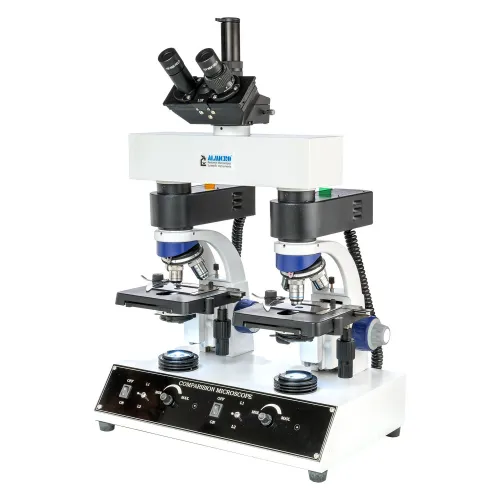

Comparison Forensic Microscope (ACM)
ALMIRO Comparison Forensic Microscope were developed about four decades ago in consultation with the leading Scientists and Criminologists of world repute, thereafter The instruments are being continually updated. Comparison Microscope are the most advanced & versatile instruments invented for comparative Micro study in Forensic Science, geology, Metallurgy, Mineralogy, Crystallography and Chemical Microscopy.
Comparison Forensic Microscope (ACM)
Technical Specifications – Comparison Forensic Microscope ACM ALMIRO
| Specification | Details |
|---|---|
| Microscope Type | Dual-microscope comparison system |
| Optical Design | Advanced opto-mechanical comparison optics |
| Observation Mode | Simultaneous left–right split image viewing |
| Objectives | 4X, 10X, 20X, 40X (Incident Light) |
| Eyepieces | WX 10X paired eyepieces |
| Magnification Range | 20X to 400X |
| Illumination | Heavy Incident Light + Transmitted Light |
| Applications | Forensic Science, Metallurgy, Mineralogy, Geology, Crystallography, Chemical Microscopy |
| Historical Development | Designed in collaboration with leading global scientists; continuously updated over four decades |
Key Features – Comparison Forensic Microscope ACM ALMIRO
Dual-Microscope Comparison System
-
Allows two micro-samples to be viewed simultaneously.
-
Left and right images appear together for direct visual comparison.
High-Precision Optics
-
Objectives from 4X to 40X enable inspection at multiple magnification levels.
-
Wide-field 10X eyepieces provide clear, sharp, and comfortable viewing.
Wide Magnification Range
-
Covers 20X to 400X for basic and advanced forensic studies.
-
Ideal for analyzing surface patterns, texture differences, and micro-markings.
Advanced Illumination
-
Heavy incident lighting highlights surface structures and tool marks.
-
Transmitted light supports analysis of transparent samples.
Versatile Scientific Applications
-
Suitable for firearms examination, fiber comparison, ink differentiation, mineral study, and metallurgical evaluation.
Robust Opto-Mechanical Construction
-
Built for long-term, stable performance in demanding forensic environments.
-
Engineered to support continuous research and evidence analysis.
Working Purpose / Applications
The ACM ALMIRO Comparison Forensic Microscope is designed for precise comparative micro-analysis where two samples must be viewed side by side. Common uses include matching bullet striations, tool marks, paint layers, fibers, inks, metals, minerals, and crystal structures. It is extensively used in forensic laboratories, universities, research centers, and industrial inspection units.