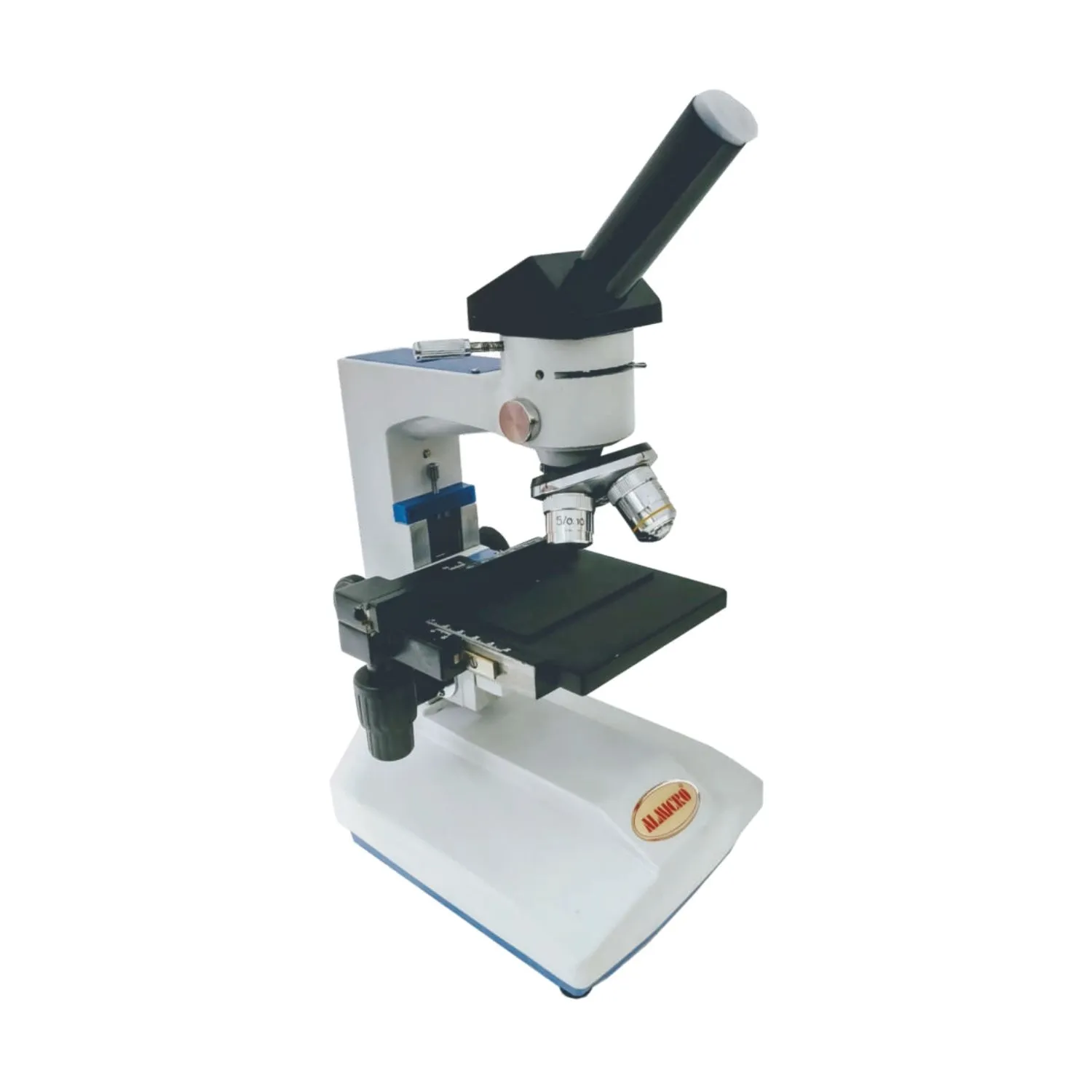
Inclined Metallurgical Microscope (MM - 2)
The MM-2 Inclined Metallurgical Microscope is designed for reflected light examination of opaque metallic specimens in laboratory environments. It features a monocular observation tube inclined at 45 degrees, a rigid mechanical body, and a graduated mechanical stage for controlled sample positioning. Bright field horizontal illumination with diaphragm controls, precision nosepiece, and variable light intensity enable accurate surface structure analysis in metallurgical and material testing laboratories.
Inclined Metallurgical Microscope (MM - 2)
Technical Specification Table
| Specification | Details |
|---|---|
| Model | MM-2 |
| Microscope Type | Inclined Metallurgical Microscope |
| Observation Tube | Monocular, inclined at 45° |
| Illumination Type | Bright field horizontal illuminator |
| Illumination Features | Centering provision, field diaphragm, aperture diaphragm, filter slots |
| Nosepiece | Quadruple revolving nosepiece |
| Stage Type | Graduated mechanical stage |
| Light Control | Variable light control transformer |
| Objectives | LWD M10X and M45X (SL) |
| Eyepieces | Wide field WF10X and H15X |
| Packaging | Inner thermocol or styrofoam packing with outer cardboard box |
Key Features
-
Monocular observation tube inclined at 45 degrees
-
Designed for reflected light metallurgical examination
-
Bright field horizontal illumination system
-
Integrated field and aperture diaphragms
-
Provision for centering and filter insertion
-
Quadruple revolving nosepiece for objective selection
-
Graduated mechanical stage for precise specimen movement
-
Variable light intensity control transformer
-
Long working distance metallurgical objectives
-
Wide field eyepieces for comfortable observation
-
Stable mechanical construction for laboratory use
Working Principle
The MM-2 Metallurgical Microscope operates by directing reflected light from a horizontal illuminator onto the surface of opaque specimens. The reflected light is collected by metallurgical objectives and transmitted through the optical system to the eyepiece for observation. Adjustable diaphragms control contrast and illumination intensity, while the graduated mechanical stage enables accurate positioning of samples for consistent surface structure evaluation.
Applications / Use Cases
-
Metallurgical surface structure examination
-
Material science laboratory analysis
-
Quality control of metallic components
-
Failure analysis of metal samples
-
Educational training in metallurgical microscopy
-
Industrial inspection of treated surfaces