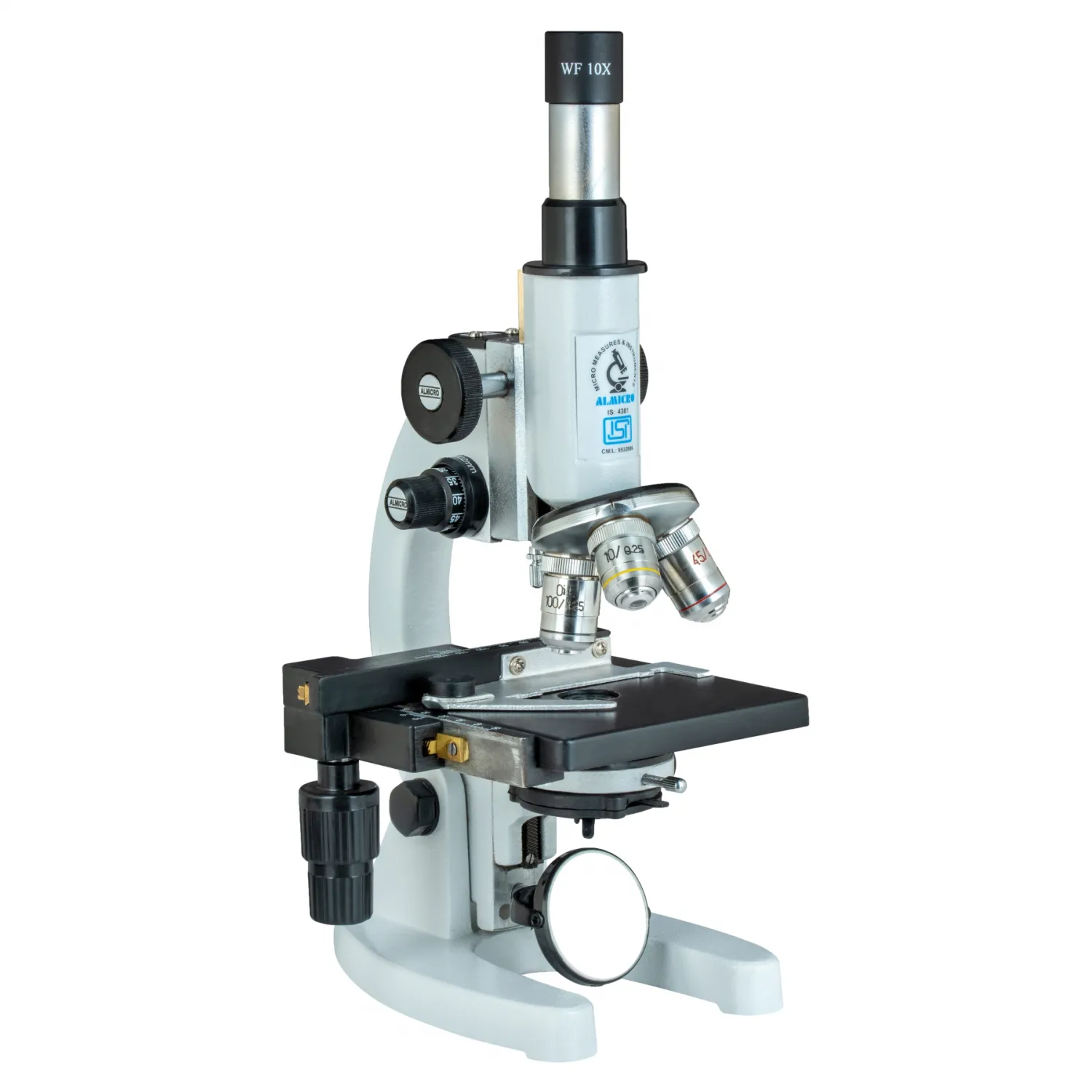

Pathological Medical Microscope (BM-5)
Pathological Medical Microscope(BM-5)
Pathological Medical Microscope (BM-5)
Technical Specifications – Pathological Medical Microscope BM-5
| Specification | Details |
|---|---|
| Observation Tube | Mechanical tube length 160 mm; equipped with triple nosepiece |
| Focusing System | Separate coarse and fine motion for accurate focusing |
| Mechanical Stage | Detachable horizontal mechanical stage 120 × 120 mm; graduated; smooth slide movement adjustments |
| Condenser | Double-lens bright field Abbe condenser NA 1.25; fixed below stage; iris diaphragm; swing-out filter holder; rack & pinion movement |
| Safety Features | Adjustable down stopper to prevent slide damage |
| Illumination | Plano-concave mirror for bright, uniform illumination |
Key Features – Pathological Medical Microscope BM-5
Classic Pathological Design
Equipped with 160mm mechanical tube
Triple nosepiece for essential objective configurations
Smooth Coarse & Fine Focusing
Separate focusing knobs for precise control
Ideal for routine pathology and student training
Versatile Mechanical Stage
Detachable graduated stage for flexible use
Easy slide navigation and stable positioning
Reliable Bright-Field Optics
Abbe condenser NA 1.25 with iris diaphragm
Rack & pinion movement for illumination accuracy
Safe & Durable Operation
Down stopper prevents accidental slide breakage
Sturdy construction suitable for continuous lab use
Mirror-Based Illumination
Plano–concave mirror for even, natural light
Perfect for locations without electrical illumination needs
Frequently Asked Questions
Q1. What type of microscope is the BM-5 based on its visible configuration?
The BM-5 is a compound medical microscope designed for slide-based observation under transmitted light. Its inclined monocular tube, revolving nosepiece, mechanical stage, and substage condenser indicate suitability for routine medical and laboratory microscopy.
Q2. How does the mechanical stage improve practical slide handling?
The fixed mechanical stage with X–Y movement allows precise and controlled positioning of slides. This is especially useful when scanning specimens systematically, reducing the need to touch the slide directly during observation.
Q3. What level of observation work is this microscope visually suited for?
Based on its objective setup and condenser system, this microscope is suitable for routine medical, educational, and basic laboratory examinations. It supports detailed study of tissues, cells, and microorganisms but is not meant for advanced research imaging.
Q4. How does the focusing system support accuracy and safety?
The presence of separate coarse and fine focusing knobs allows smooth and gradual focusing. An adjustable down-stop helps prevent accidental contact between the objective lens and slide, which is important in regular lab use.
Q5. What can be inferred about illumination from the visible design?
The microscope uses a substage plano-concave mirror to reflect external or natural light through the specimen. This allows operation without an internal electrical light source, though illumination quality depends on ambient lighting conditions.
Q6. What does the build and finish suggest about durability and maintenance?
The heavy die-cast body and wide base indicate a stable and durable construction suitable for frequent laboratory handling. Maintenance requirements are minimal and mainly involve routine cleaning of lenses, stage surfaces, and smooth operation of mechanical parts.