
Microscope Manufacturer in India: How to Choose the Best Supplier?
India has no shortage of microscope manufacturers and suppliers, but the differences between them rarely show up on a product listing. A microscope that works perfectly in a school laboratory can be the wrong instrument entirely for a pathology lab, a research department or an industrial inspection line. What actually matters is the application, the optical quality, how wide the model range is, the manufacturing capability behind it, and the support a buyer gets once the sale is done. Price plays a role, sure, but it shouldn't be the deciding factor. A poorly matched instrument ends up costing far more in lost working time than it ever saved at purchase. This guide explains how to evaluate a Microscope Manufacturer in India before committing to a supplier.
How Do You Choose a Microscope Manufacturer in India?
Start with the application, then work through the specifications. That means the microscope type suited to your specimens, the optical quality, the objective and eyepiece configuration, the illumination system, the focusing mechanism and the mechanical construction. Once that's settled, look at the supplier itself: how many models it actually offers, whether technical support is available before and after purchase, which quality certifications apply, what warranty and service terms are on the table, and how long the company has been making scientific instruments in the first place. A suitable manufacturer should be able to recommend a microscope based on the buyer's actual application, not just push whatever costs the most.
What Should You Look for in a Microscope Manufacturer in India?
Manufacturing Experience
Operating history is a useful signal, but only when it's tied to the actual product category. A company that has been making optical and scientific instruments for decades has, in most cases, already run into and solved the problems that show up in daily laboratory use, things like stage alignment, focus drift, illumination consistency, and whether spare parts are still around several years after purchase.
Buyers comparing microscope manufacturers in India should look beyond marketing claims and check the manufacturer's actual experience with scientific and optical instruments. A simple test works well here. Ask a technical question about a specific model and see whether the answer comes back in specifications or in adjectives.
Range of Microscopes
A manufacturer's catalogue is a fairly honest indicator of which applications it actually serves. The common categories to look for include student microscopes, compound microscopes, monocular, binocular and trinocular models, stereo microscopes, research microscopes, digital microscopes, metallurgical microscopes, polarizing microscopes, and fluorescence microscopes.
A supplier with only two or three configurations will usually end up pushing whatever happens to be in stock, regardless of fit. One with a properly developed range has room to actually match the instrument to the specimen.
Technical Support and Product Guidance
Before recommending a model, a manufacturer should be asking questions, not just quoting a price: what's the specimen, what magnification and resolution does the work need, what illumination is required, do images need to be captured, and how often will the instrument actually run. A microscope working eight hours a day in a diagnostic laboratory needs a very different build quality than one used twice a week in a classroom.
Choose a Microscope According to Its Application
| Application | Suitable Microscope Type | Important Buying Factor |
|---|---|---|
| School Laboratories | Student / Monocular Microscope | Simple operation and durability |
| College Biology Labs | Compound / Binocular Microscope | Optical clarity and precise focusing |
| Medical Laboratories | Binocular / Trinocular Microscope | High resolution and comfortable viewing |
| Research Laboratories | Research / Trinocular Microscope | Advanced optics and imaging capability |
| Industrial Inspection | Stereo / Metallurgical Microscope | Working distance and specimen type |
| Documentation and Imaging | Digital / Trinocular Microscope | Camera and imaging compatibility |
A microscope that's ideal for a school laboratory can be entirely wrong for medical diagnostics, research or industrial inspection, and it helps to know why. School instruments are built around durability and simple handling above everything else. Diagnostic work leans on resolution and on viewing comfort across long sessions. Industrial inspection, meanwhile, usually needs working distance and room above the specimen rather than raw magnification, which is exactly why stereo and metallurgical models take over from standard compound microscopes there.
Defining the application first also heads off the most common buying mistake: paying for more magnification than the sample or the optics can actually put to use.
How to Evaluate Microscope Quality Before Buying
Objective Lenses and Optical Quality
Objectives decide most of what you actually see through the eyepiece. Check which ones come as standard, whether they're achromatic or plan corrected, and what numerical aperture they offer, since numerical aperture sets the real resolving limit, not magnification. It's worth checking edge of field clarity, colour fidelity and contrast on an actual sample before you buy, not just on paper.
Eyepiece and Viewing Head
Monocular heads work fine for basic teaching use. Binocular heads cut down on eye strain and are really the practical minimum for laboratory work. Trinocular heads add a third port for a camera, which makes them the right choice wherever images need to be recorded or shared. Interpupillary adjustment and dioptre correction start to matter as soon as more than one person is sharing the same instrument.
Focusing System
Coarse and fine focus should move smoothly, hold their position without drifting, and return reliably to the same plane. On instruments used by students, tension adjustment and a focus stop that protects the slide and the objective are genuinely useful, not just nice extras.
Illumination and Condenser
Look at the illumination type, LED in most current models, along with intensity control and how evenly the light spreads across the field. The condenser and iris diaphragm work with the objective to control contrast and resolution, which is why an adjustable Abbe condenser does more for most transmitted light work than simply having a brighter lamp.
Mechanical Stability
A stable stand, a mechanical stage with smooth X and Y movement, controls that sit within easy reach, and a solid metal body all quietly decide how the instrument holds up after a few years of use. When you see vibration or flex at higher magnification, it usually traces back to construction quality, not the optics.
Higher magnification alone does not mean a better microscope. Image resolution, optical quality, illumination and mechanical stability are equally important.
Why Product Range Matters When Selecting a Supplier
Product range works as a practical filter more than a vanity metric. Education, healthcare, scientific research, industrial inspection and specialized microscopy each place different demands on optics, viewing heads, stages and illumination, and a supplier manufacturing across all of these has already engineered for those differences. That usually means matching accessories, objectives and spare parts can come from the same source instead of being chased down separately.
When comparing the best microscope manufacturers in India, buyers should check whether the company offers application specific models rather than a very limited range. It also matters for institutions that grow over time. A college adding a research wing, or a laboratory adding imaging later on, is better served by a supplier whose catalogue can expand along with the requirement rather than one that's already maxed out.
Quality Standards and Certifications to Check
A certification doesn't mean every microscope from that manufacturer suits every application, but it does provide real evidence about the quality management systems and compliance processes behind the products. It confirms that documented procedures exist for design, production, inspection and corrective action, which is precisely what institutional and government buyers are typically asked to verify during tendering.
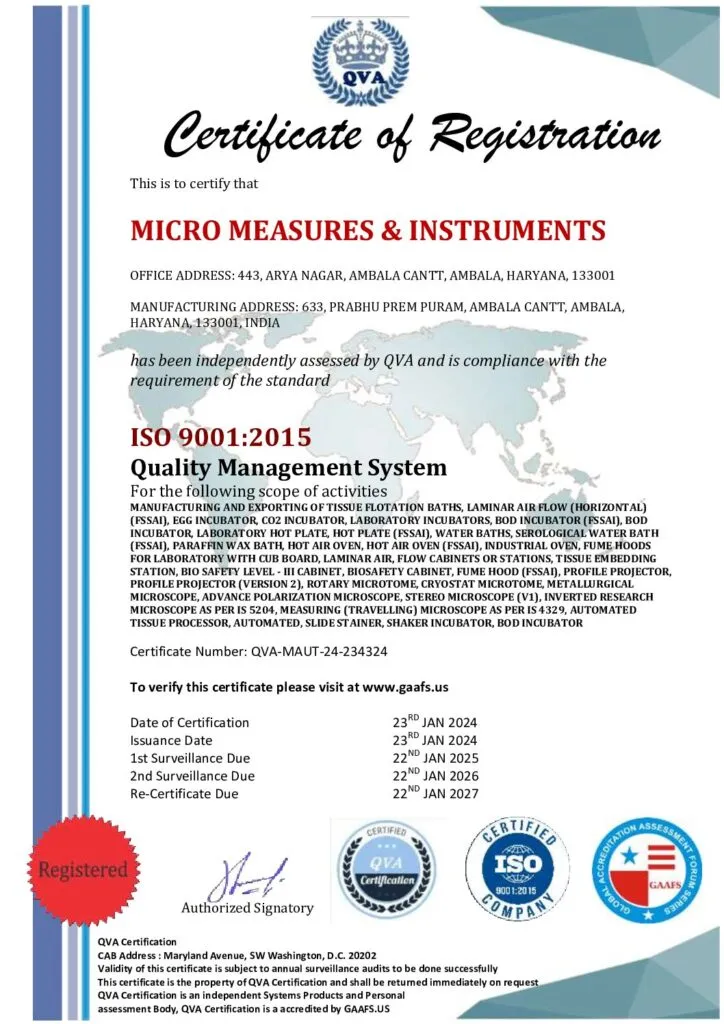
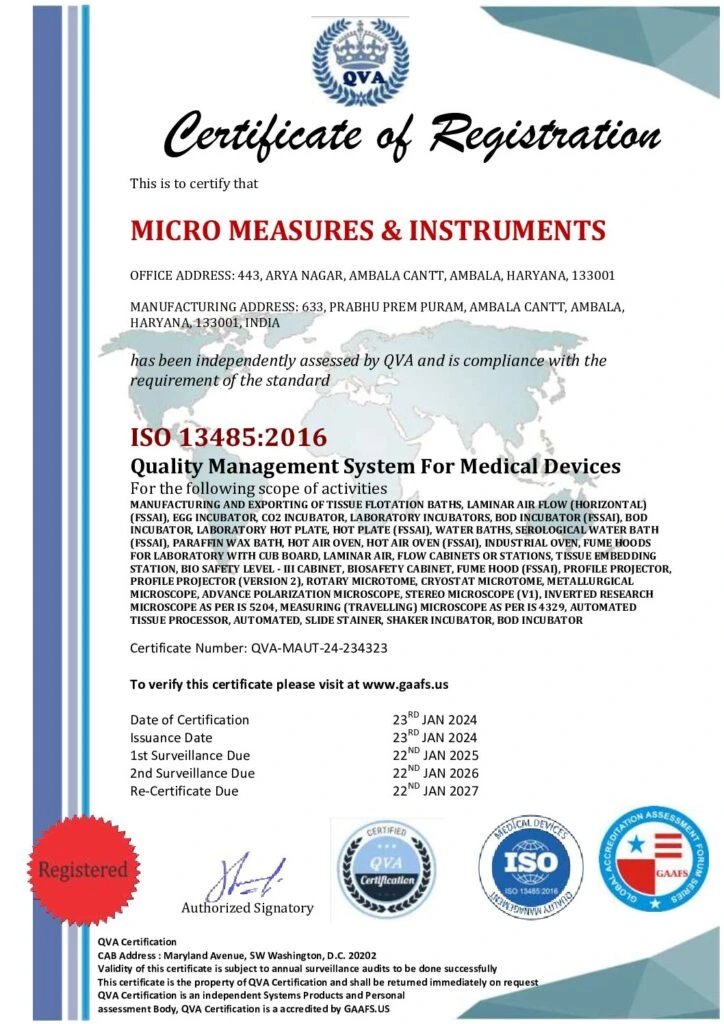
ALMICRO, the microscope brand of Micro Measure & Instruments, holds the following quality management credentials:
ISO 9001:2015, Quality Management Systems
ISO 13485:2016, Quality Management Systems for Medical Devices
Certificate of Compliance for the applicable product scope

Certification scope can vary by product, so it's worth confirming which standards apply to the specific model being considered. View ALMICRO quality certifications and compliance documentation
Manufacturer Experience and Industry Presence
ALMICRO (Micro Measure & Instruments)
Almicro (Micro Measure & Instruments) has been manufacturing microscopes and scientific instruments since 1978, supplying its microscope range under the ALMICRO. The product line covers educational, laboratory, research, industrial and specialized microscopy, and it's built on in house manufacturing rather than sourcing from third parties.
Factory: #633 to 634, Prabhu Prem Puram, Ambala Cantt, Haryana 133001
Registered Office: 443, Arya Nagar, Jagadhari Road, Ambala Cantt, Haryana 133001
Branch Office: C 804, Spectra Raaya, Siddapura, Whitefield, Bengaluru, Karnataka 560066
Real Product Showcases and Scientific Exhibitions
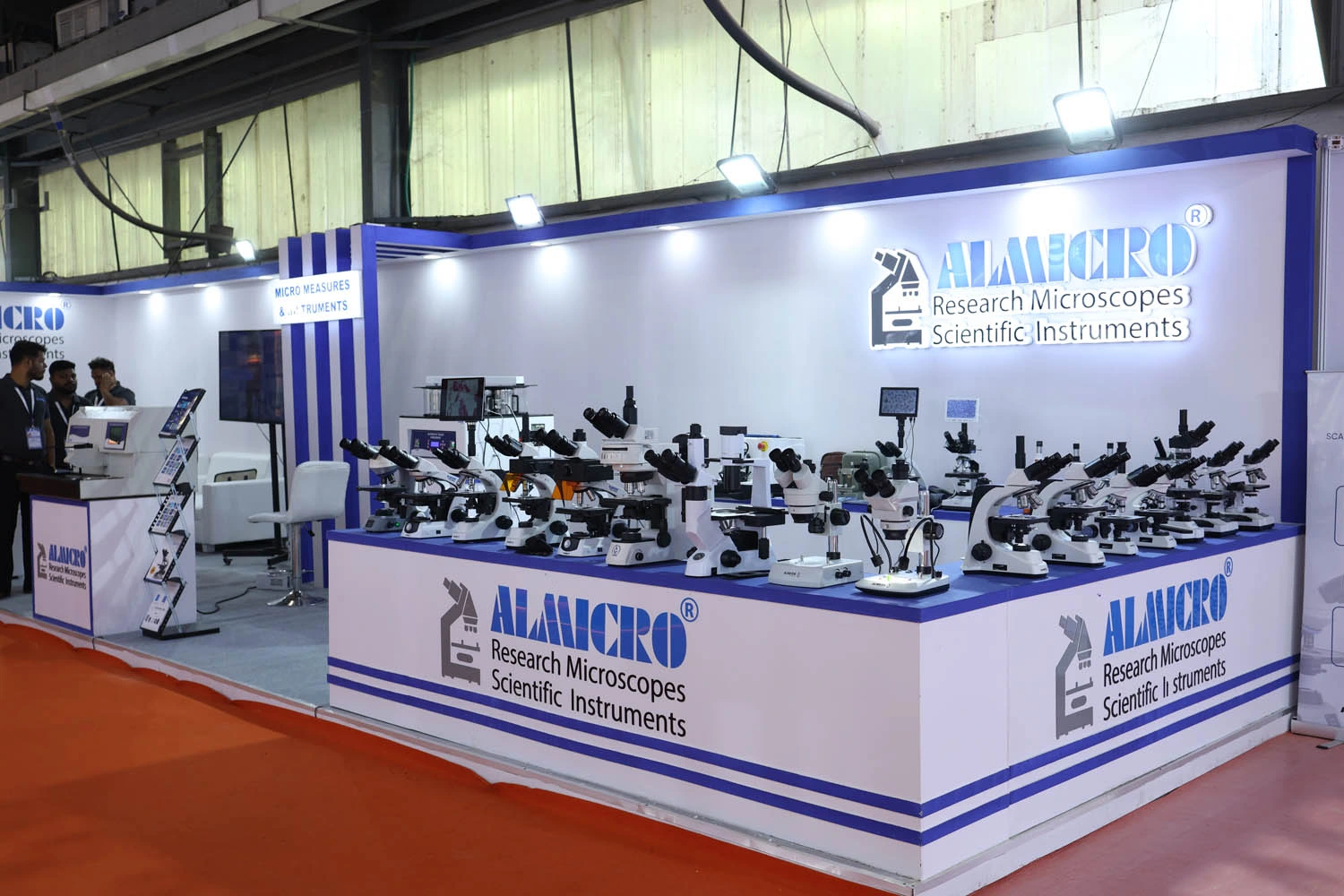
Scientific instrument exhibitions are one of the few places where microscope configurations can actually be compared side by side before purchase. Institutions get to see how different viewing heads and stages handle in practice, technical teams can demonstrate instruments on real samples, and buyers can size up models from several manufacturers in one place instead of relying on catalogue photographs alone.
View more exhibitions and product showcases
Manufacturer vs Trader or Reseller: What Is the Difference?
Every microscope supplier in India falls into one of these two categories, and the difference shapes what you can realistically expect after the sale.
| Microscope Manufacturer | Trader / Reseller |
|---|---|
| Direct knowledge of microscope product specifications | May source microscopes from multiple companies |
| Greater possibility of microscope configuration guidance | Depends on supplier availability and product range |
| Technical product support may be provided directly | Technical support may pass through another supplier |
| Bulk orders and custom microscope requirements are easier to discuss | Customization options can be limited |
Going with a manufacturer isn't always the better call. An established trader with strong local service coverage can sometimes support a small laboratory better than a distant manufacturer ever could, and resellers often carry a wider selection of imported models than any single factory produces on its own.
The distinction matters most when configuration changes, bulk institutional supply, or long term availability of spare parts and objectives are involved. In those cases, buying closer to the source usually shortens response time. Weigh quality, service, technical knowledge, availability, warranty and suitability on their own merits first, then decide which route actually delivers them.
Questions to Ask Before Selecting a Microscope Supplier in India
Most institutional buyers only find out what a supplier actually offers after the purchase order is signed. Asking these questions upfront, and getting them answered in writing, saves that surprise:
- Which microscope model actually matches my specimen type and required magnification, not just the price I want to pay?
- What objectives and eyepieces come standard, and are they achromatic or plan corrected?
- What is the usable resolution at maximum magnification, not just the total magnification printed on the box?
- What illumination system is fitted, and can intensity be adjusted for different specimen types and thicknesses?
- Will this build hold up under continuous multi-hour daily use without focus drift, overheating or premature wear?
- Are objectives, eyepieces, bulbs and other spares stocked and sold individually, or only as a full-unit replacement?
- What exactly does the warranty cover, for how long, and who actually handles service, the manufacturer directly or a third party?
- Can a complete specification sheet be provided in writing before purchase, not just described over a call?
- Can bulk or institutional orders be fulfilled, and what is the realistic delivery timeline at that quantity?
- Which certifications apply to this specific model, not just to the company in general?
A microscope supplier in India who can answer all ten in writing, with real numbers instead of reassurances, is one worth trusting with an institutional order.
Why Buyers Consider ALMICRO When Comparing Microscope Manufacturers in India
For buyers researching microscope manufacturers in India, ALMICRO is one manufacturer that can be evaluated on measurable factors such as operating history, available microscope categories, quality management certifications and published product specifications.
What a buyer can actually verify includes manufacturing activity going back to 1978, a range covering student, compound, binocular, trinocular, stereo, research, digital, metallurgical and polarizing configurations, ISO 9001:2015 and ISO 13485:2016 certification, exhibition participation, and registered manufacturing and office locations across India.
None of this makes any one manufacturer the right fit for every laboratory. What it does is give a buyer concrete criteria to compare against other suppliers, which is a lot more useful than a ranking claim ever would be. Explore the microscope range or review microscope types and their applications before shortlisting.
How to Choose the Right Microscope for Your Requirement
Step 1. Define the specimen and the application. Blood smears, botanical sections, circuit boards and metal surfaces lead to entirely different instruments.
Step 2. Determine the magnification and, more importantly, the resolution the work actually requires.
Step 3. Choose the viewing head. Monocular for basic teaching, binocular for routine laboratory work, trinocular where imaging is needed.
Step 4. Check the objectives supplied and the illumination and condenser system.
Step 5. Decide whether images must be captured, measured or shared, and confirm camera compatibility if so.
Step 6. Compare specifications, warranty, service response and technical support across shortlisted suppliers.
The best microscope manufacturer in India for a particular buyer is therefore not necessarily the company with the biggest claims. It is the supplier whose microscope specifications, quality, support and application expertise best match the requirement.
Frequently Asked Questions
Who is the best microscope manufacturer in India?
It depends entirely on the application, so there isn't one universal answer here. Compare product range, optical performance, technical specifications, certifications, manufacturing experience, after sales support and overall suitability for your laboratory. ALMICRO is one option buyers can evaluate against these criteria, alongside others.
What is the best microscope company?
It depends on whether the microscope is needed for education, medical laboratories, research or industrial inspection. Evaluate companies on optical performance, application suitability, reliability and service rather than brand name alone.
What is the best quality microscope available in India?
There is no single model that suits every user. A school, a medical laboratory, a research centre and an industrial facility need different specifications. Judge quality by optical resolution, the objectives supplied, focusing precision, illumination control, mechanical stability and fitness for the intended application.
How do I choose a good microscope?
Match the instrument to the intended application, check optical quality and usable resolution rather than magnification alone, confirm the illumination system suits your specimens, assess construction quality for the expected daily use, and verify what after sales support is available.
Which microscope brand is best?
The right microscope brand depends on application, specifications, budget, service support and the long term availability of parts and accessories. A reliable microscope brand for one laboratory may be the wrong fit for another.
What is the best microscope company in the world?
Microscopy is too broad a field for one company to lead across the board globally. Different manufacturers specialize in education, clinical microscopy, research imaging, industrial microscopy and advanced scientific systems, and being strongest in one of those areas doesn't carry over to the others.
Make the Right Choice
Choosing a Microscope Manufacturer in India comes down to a few checks done in the right order: define the application, confirm the optical specifications, assess manufacturing experience and product range, verify quality systems, and establish what technical support and after sales service you will receive. Certifications and company history support that decision, but the specification sheet and the supplier's willingness to explain it remain the strongest evidence.
ALMICRO (Micro Measure & Instruments) offers multiple microscope configurations across educational, laboratory, research and specialized applications. Buyers should review the relevant model specifications and talk through their intended application before settling on an instrument.