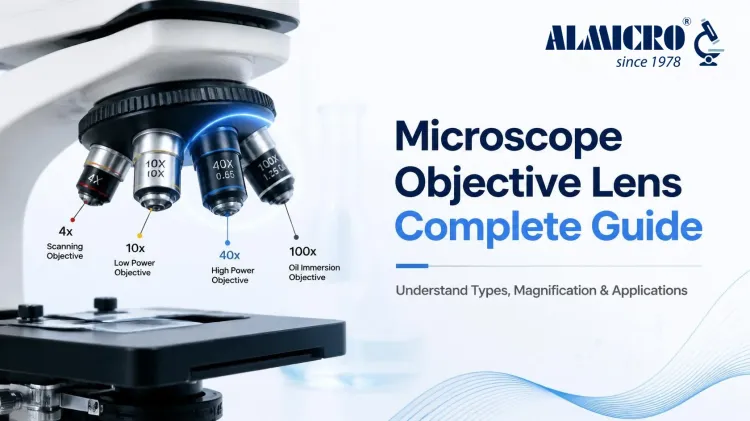
Microscope Objective Lens Complete Guide by Almicro Microscope
Ever wondered which tiny glass component does the real magnification work inside a microscope? The microscope objective lens is the answer. Mounted directly on the nosepiece, it is the most critical optical component in any microscope, gathering light from the specimen and forming the primary magnified image.
At Almicro Microscope, we manufacture and supply precision-grade objective lenses built for laboratories, classrooms, and research facilities across India.
Here's what this guide covers: function, anatomy, types, magnification, color coding, and price, so you can choose the right lens with confidence.
What Does a Microscope Objective Lens Do?
The microscope objective lens function centers on two jobs magnifying the specimen and resolving fine detail.
- Collects light reflected or transmitted from the specimen
- Resolves fine structural details in the sample
- Forms a real image (not the virtual image created later by the eyepiece)
- Determines resolving power through its numerical aperture (NA)
- Sets total magnification together with the eyepiece objective power × eyepiece power (a 40× objective with a 10× eyepiece gives 400× total)
A higher NA value means better resolving power, so finer specimen details become visible.
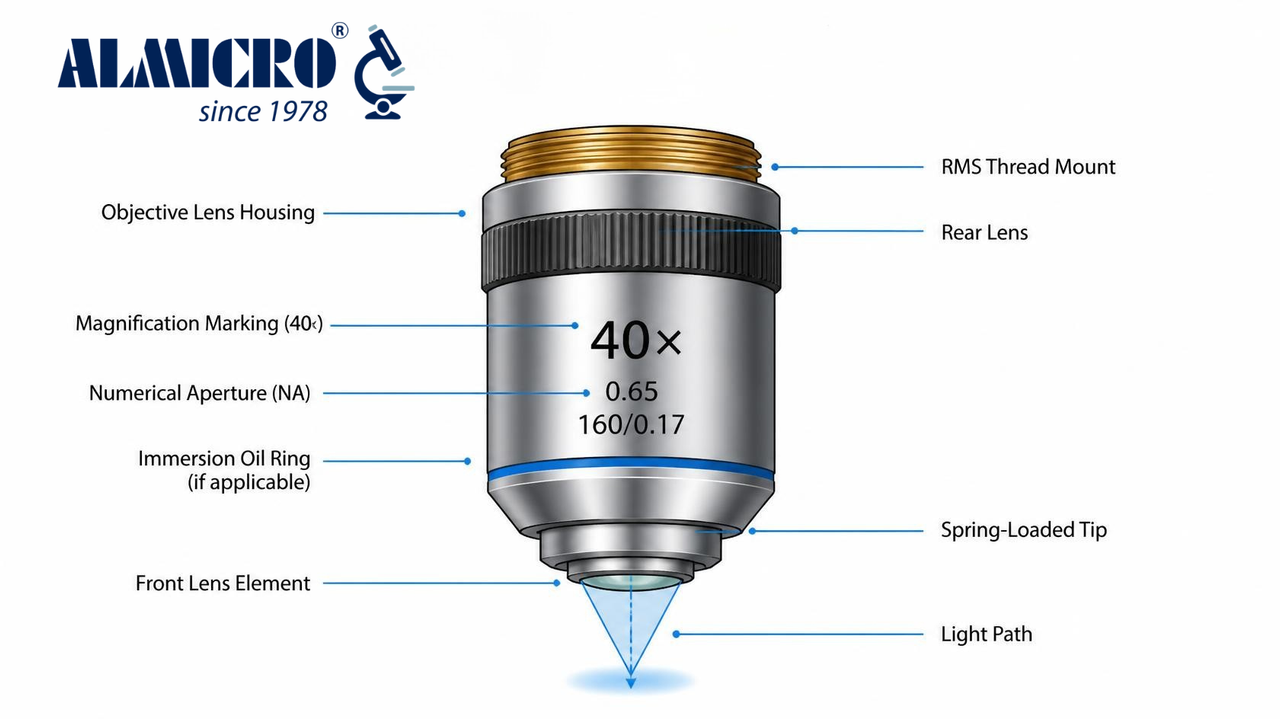
Microscope Objective Lens Diagram and Anatomy Explained
A labeled microscope objective lens diagram makes correct mounting, focusing, and image clarity easier to understand.
Key parts to know:
- Front lens element – closest to the specimen, gathers the initial light
- Barrel – houses the internal lens elements; barrel length affects working distance
- Parfocal shoulder – keeps the specimen in focus when switching objectives, maintaining parfocal distance
- Thread mount – follows the DIN standard thread for universal nosepiece compatibility
- Magnification engraving – shows power (4×, 10×, 40×, 100×)
- NA value – printed alongside the magnification number
- Color band – a quick visual identifier for power level
For a full labeled diagram of every microscope component, see our guide → Microscope Types and Diagrams
Types of Microscope Objective Lenses
Microscope objective lens types differ mainly in how they correct optical aberration, which affects both image sharpness and cost.
- Achromatic – corrects chromatic aberration for two wavelengths; the most common choice for student and lab microscopes
- Plan Achromatic – adds flat-field correction so the entire field of view stays sharp edge to edge
- Semi-Plan – moderate flat-field correction at a cost-effective mid-range price point
- Plan Apochromatic – corrects both chromatic aberration and spherical aberration at the highest level; used in advanced research microscopy
Almicro Microscope manufactures achromatic and plan-achromatic objectives suited for education and industrial inspection.
Microscope Objective Lens Magnification Explained
Standard microscope objective lens magnification levels each serve a different observation purpose.
- 4× – scanning objective, used to locate the specimen area
- 10× – low power, for general observation
- 40× – high power (high-dry), for detailed cellular structure
- 100× – oil immersion, for the finest structural detail
With a 10× eyepiece, a 40× objective gives 400× total magnification.
A few trade-offs worth knowing:
- Higher magnification narrows the field of view
- Higher magnification reduces depth of field
- Working distance shrinks as magnification increases
- 100× oil-immersion objectives need immersion oil to reach their rated NA
Microscope Objective Lens Colors and What They Mean
The ISO 8578 color coding system lets you identify microscope objective lens power at a glance, without reading the engraved numbers.
- Red – 4× (scanning)
- Yellow – 10× (low power)
- Blue – 40× (high-dry)
- White or Ivory – 100× (oil immersion)
These color bands are the microscope objective lens names most lab users rely on day to day; "the yellow objective" simply means the 10× lens. The system also speeds up nosepiece identification on a quick-change turret. Almicro Microscope objectives follow standard ISO color banding for universal compatibility across microscope brands.
What Affects Microscope Objective Lens Price?
Several factors influence microscope objective lens price:
- Optical correction level (achromatic costs less than plan-apochromatic)
- Magnification power (higher magnification generally costs more)
- Coating quality (multi-coated, anti-reflection optics improve light transmission and cost more)
- Brand and manufacturing origin
- Order volume (OEM pricing and bulk supply bring per-unit costs down)
As a general guide, student-grade achromatic lenses sit at the more affordable end, while research-grade plan-apochromatic lenses cost significantly more due to their advanced correction. Almicro Microscope is a cost-effective Indian manufacturer, offering quality optics at competitive pricing without compromising precision. Contact us for a quote suited to your exact specification and order volume.
How to Choose the Right Objective Lens
Selecting the correct objective lens comes down to four questions:
- What is application education, research, or industrial quality control?
- What magnification range does your typical sample require?
- What level of aberration correction does your imaging work need?
- What is the available budget for this upgrade?
A well-matched objective lens is often the single most impactful upgrade for any microscope. Almicro Microscope brings decades of manufacturing experience to help you match the right lens to your application.
Conclusion
The microscope objective lens is the heart of any microscope's optical system. Its type, magnification, and quality directly determine what you can observe, from a basic student sample to fine cellular structures under oil immersion.
Whether you need achromatic objectives for your classroom lab or plan-achromatic lenses for quality inspection, Almicro Microscope delivers precision optics at the best value. Explore our full microscope range or contact us for a custom quote.