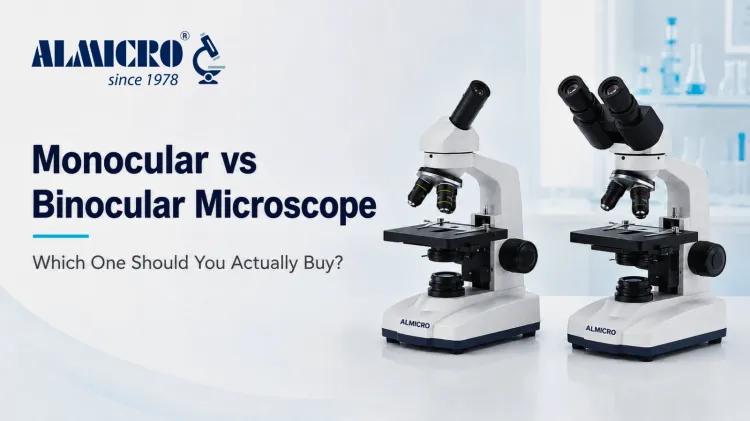
Monocular vs Binocular Microscope: Which One Should You Actually Buy?
Walk into any microscope catalog and you'll find monocular and binocular models sitting side by side, often with similar magnification ranges and near identical price tags. The real difference usually comes down to something the spec sheet doesn't explain: how comfortable the microscope actually is to use for hours at a stretch.
One eyepiece, or two. That's the basic split. A monocular microscope is viewed through a single eye, while a binocular microscope uses both. In a monocular vs binocular microscope comparison, this comfort factor is the real deciding point, not magnification, since both types can use identical lens combinations.
This guide walks through their features, main parts, advantages, limitations and applications, so schools, colleges, laboratories and institutional buyers can settle on the configuration that actually fits how they'll use it.
What Is a Monocular Microscope?
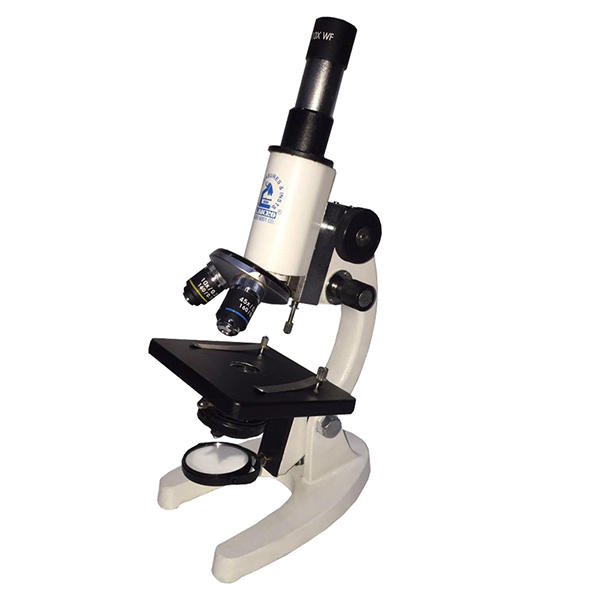
As the name suggests, a monocular microscope is a light microscope with just one eyepiece, viewed through a single eye at a time. It's the default choice in schools and basic laboratories, since observation sessions there tend to be short.
They also tend to be lightweight and simple to operate, which is exactly why they work well for beginners.
Main Parts of a Monocular Microscope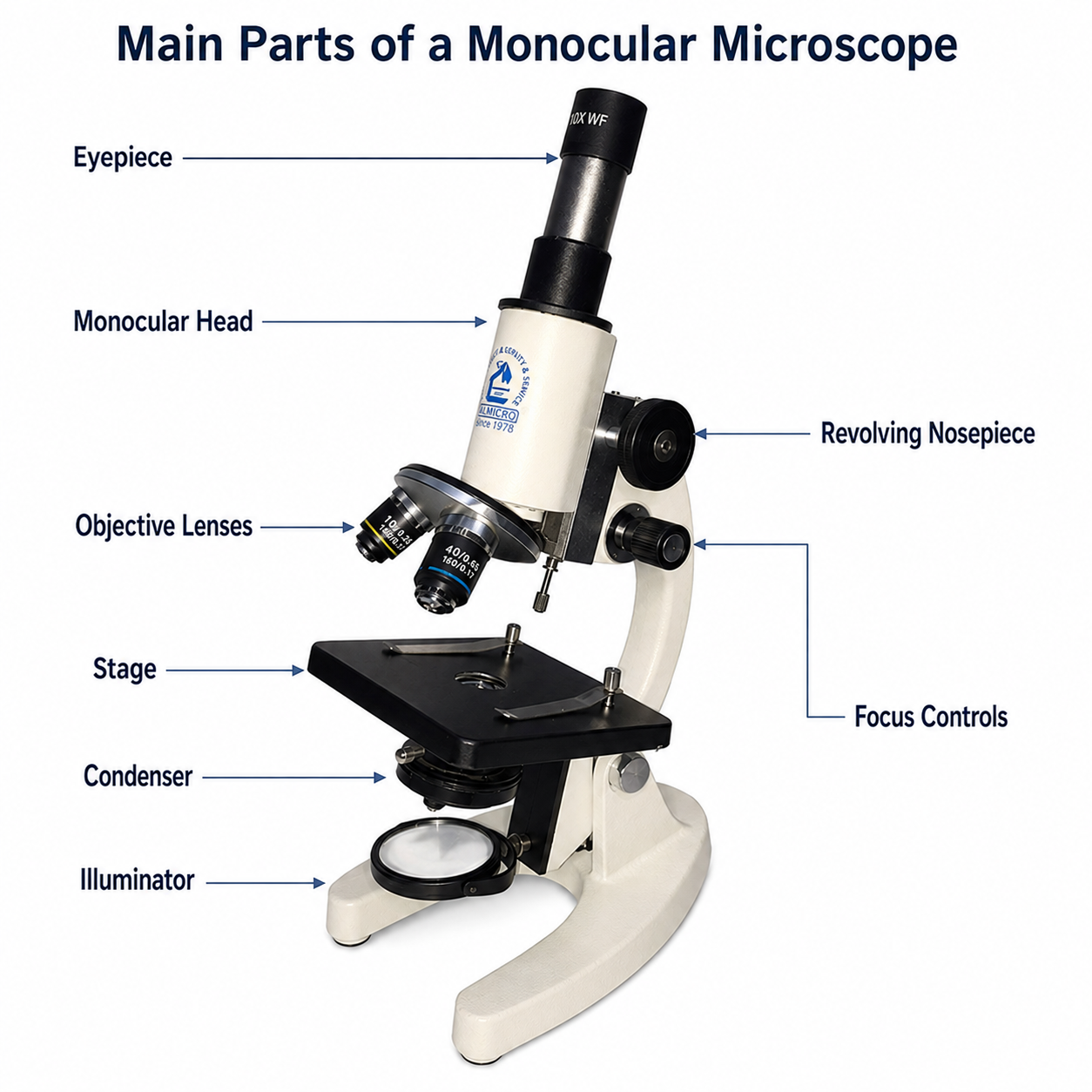
A monocular microscope is typically built around these parts:
- Eyepiece — The lens at the top of the tube that magnifies the image formed by the objective lens for direct viewing. Standard eyepieces are usually 10x or 15x.
- Monocular head — The single, angled viewing tube that houses the eyepiece and sends the image path to one eye only. It's the defining feature that makes the microscope "monocular."
- Objective lenses — The lenses closest to the specimen that capture light and form the first magnified image. Several objectives (commonly 4x, 10x, 40x) sit on the nosepiece for different magnification levels.
- Revolving nosepiece — The rotating turret beneath the head that holds the objective lenses in place. Turning it clicks a different objective into the light path, changing magnification instantly.
- Stage — The flat platform where the glass slide rests during observation. Basic stages hold the slide in place with simple clips.
- Condenser — The lens assembly under the stage that gathers and focuses light onto the specimen. It controls light angle and intensity, directly affecting image sharpness and contrast.
- Illuminator — The built-in light source at the base of the microscope, usually LED or halogen. It supplies the light that travels up through the condenser, specimen, and lenses.
- Focus controls — The coarse and fine knobs used to adjust the distance between the lens and specimen. Coarse focus brings the image roughly into view; fine focus sharpens it precisely.
What Is a Binocular Microscope?
A binocular microscope, on the other hand, has two eyepieces and lets you observe with both eyes at once. That extra comfort is why it shows up so often in colleges, diagnostic labs and research facilities where sessions tend to run long.
Most binocular models also come with interpupillary and diopter adjustments, so each user can fine tune the eyepieces to their own eyes, avoiding eye strain.
Here full guide for Binocular Microscope :
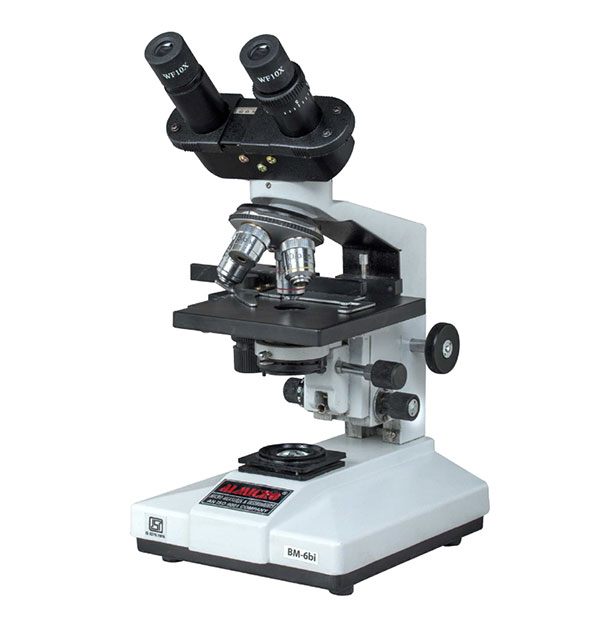
Main Parts of a Binocular Microscope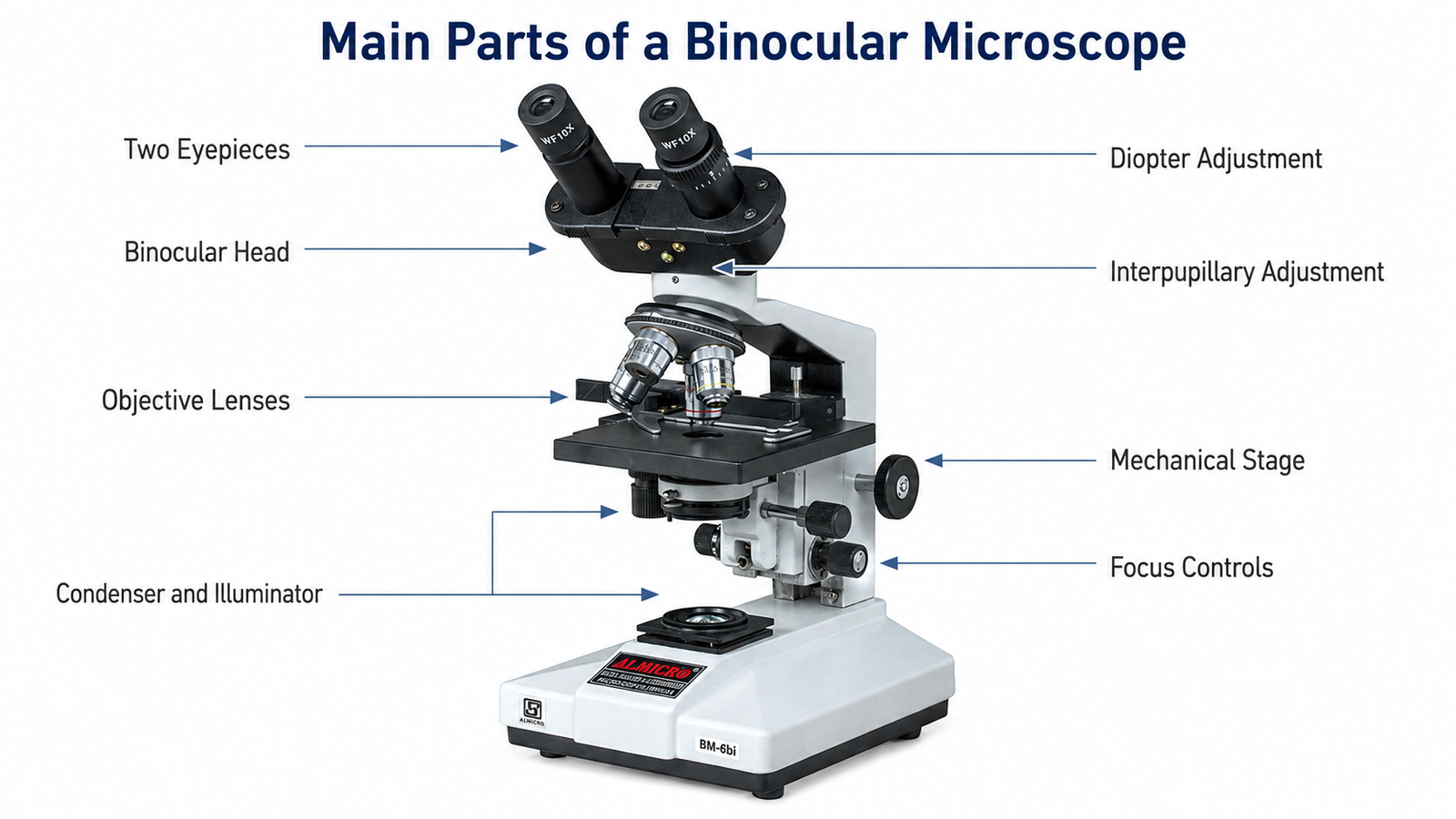
A binocular microscope is typically built around these parts:
- Two eyepieces — A matched pair of ocular lenses, one for each eye, letting you view the specimen with both eyes at once. This reduces strain compared to single-eye viewing over long sessions.
- Binocular head — The dual-tube viewing head that splits the image path from a single objective so it reaches both eyepieces. It's what separates a binocular microscope from a monocular one.
- Diopter adjustment — A small dial, usually on one eyepiece, that corrects for any difference in vision strength between the user's two eyes. It's set once per user for a sharp, balanced image.
- Interpupillary adjustment — The mechanism that slides the two eyepiece tubes closer together or further apart. It matches eyepiece spacing to the distance between the user's own pupils.
- Objective lenses — The lenses nearest the specimen that capture light and form the initial magnified image, same role as in a monocular setup. Multiple objectives on the nosepiece allow different magnifications.
- Mechanical stage — A stage fitted with control knobs that move the slide smoothly along the X and Y axes. It allows precise repositioning of the specimen without touching the slide by hand.
- Condenser and illuminator — The illuminator provides the light source at the base, while the condenser lens focuses that light onto the specimen from below. Together they set the brightness and clarity of the image.
- Focus controls — The coarse and fine adjustment knobs that bring the specimen into sharp focus for both eyepieces at once. Coarse focus handles rough positioning; fine focus refines the final image.
Difference Between Monocular and Binocular Microscope
Here's a quick side by side look at how monocular and binocular microscope models compare.
|
Feature |
Monocular Microscope |
Binocular Microscope |
|
Eyepieces |
One |
Two |
|
Viewing |
One eye |
Both eyes |
|
Comfort |
Best for short use |
Better for extended use |
|
Eye fatigue |
May occur sooner |
Generally lower |
|
Operation |
Simple for beginners |
Requires eyepiece adjustment |
|
Weight |
Usually lighter |
Usually heavier |
|
Cost |
Generally lower |
Generally higher |
|
Best suited for |
Schools and basic observation |
Colleges, labs and routine professional use |
One thing worth clearing up: the number of eyepieces has nothing to do with magnification. That's set by the eyepiece and objective lens combination, not by whether the head is monocular or binocular.
Monocular Microscope Advantages and Disadvantages
Advantages
- Simple to operate
- Suitable for beginners
- Lightweight and portable
- Generally more affordable
- Useful for short observation sessions
- Suitable for school laboratories
Disadvantages
- Only one eye is used
- May cause fatigue during long sessions
- Less comfortable for frequent laboratory work
- Limited viewing adjustments
- Not ideal for prolonged professional use
Binocular Microscope Advantages and Limitations
Advantages
- Allows viewing with both eyes
- More comfortable during extended use
- Reduces viewing fatigue
- Supports interpupillary adjustment
- Often provides diopter adjustment
- Suitable for regular laboratory work
Limitations
- Generally more expensive
- Heavier than a monocular model
- Requires correct eyepiece adjustment
- May be unnecessary for occasional basic observation
Monocular vs Binocular Microscope: Which Is Better?
For regular, extended lab work, a binocular microscope is generally the better pick. That said, a monocular microscope still makes sense for beginners, schools and shorter observation sessions.
Choose a Monocular Microscope If:
- Usage is basic or occasional
- Observation sessions are short
- Portability is important
- It is intended for beginner level education
Choose a Binocular Microscope If:
- The microscope will be used regularly
- Observation sessions are longer
- Viewing comfort is important
- It is intended for college, clinical or research work
Monocular vs Binocular vs Trinocular Microscope
Then there's the trinocular microscope, which simply adds a third port onto a standard binocular head.
|
Head Type |
Configuration |
Best Use |
|
Monocular |
One eyepiece |
Basic teaching |
|
Binocular |
Two eyepieces |
Comfortable routine observation |
|
Trinocular |
Two eyepieces and one camera port |
Observation, imaging and documentation |
Despite the name, a trinocular microscope doesn't use three eyepieces for viewing. That third port is normally reserved for a microscope camera, used for imaging or documentation.
Are Monocular and Binocular Microscopes Compound Microscopes?
Not quite the same thing. Monocular and binocular describe the viewing head, while compound refers to the magnification system, which combines an objective lens and eyepiece.
So a compound microscope can come with a monocular, binocular or trinocular head. The viewing head and the magnification system are two separate specs, so check both before buying.
How to Choose the Right Microscope
Beyond just the viewing head, a handful of practical factors will help you narrow down the right microscope for your lab or classroom:
- Purpose of observation
- Frequency of use
- Length of viewing sessions
- Required magnification
- Objective lens quality
- Illumination system
- Stage and focusing mechanism
- User comfort
- Maintenance requirements
- Warranty and after-sales support
These factors matter more than the brand name on the box. When you're comparing microscope manufacturers in India, running their specifications against this list tells you more than price alone.
Frequently Asked Questions
What is the main difference between a monocular and binocular microscope?
A monocular microscope has one eyepiece. A binocular microscope has two, letting you view with both eyes.
What are the disadvantages of monocular microscopes?
They tend to cause more eye fatigue during longer sessions, with fewer viewing adjustments overall.
Is a binocular microscope used with both eyes?
Yes. A binocular microscope is designed to be viewed through both eyepieces, once you've adjusted the distance between them correctly.
Which is better, a monocular or binocular microscope?
A monocular microscope works fine for basic, occasional use. For regular or extended lab work, a binocular microscope is the better fit.
Final Selection Guidance
In short: A monocular microscope works for simple educational observation, while a binocular microscope offers more comfort for regular laboratory use. Beyond just the viewing head, it's worth comparing optical quality, illumination, focusing controls and after-sales support before buying.
Almicro supplies both monocular and binocular microscope configurations for schools, colleges and laboratories, so you can match specifications to whatever your lab or classroom actually needs.