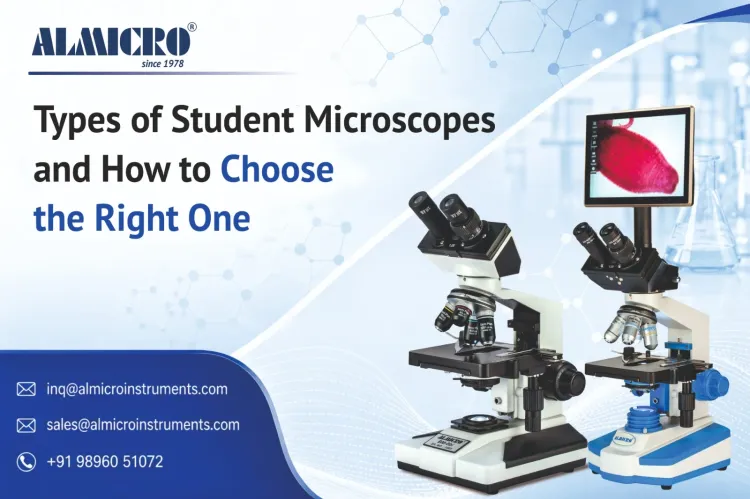
Types of Student Microscopes and How to Choose the Right One
Quick Summary
Student microscopes are the gateway to a whole hidden world: one drop of pond water, one thin slice of onion peel, and suddenly a classroom full of students is buzzing with "whoa, look at that!" moments. But choosing the right microscope isn't as simple as picking any box off a shelf. Get it wrong, and an exciting science lesson can quickly turn into a frustrating battle with blurry lenses and a focus knob that just won't cooperate.
Whether it's a school lab, a college classroom, or a home science kit, the right student microscope helps students explore the microscopic world with real clarity and confidence. At ALMICRO, we work closely with schools, colleges, and institutions every day, helping them pick student microscopes that actually match how their students learn. So let's walk through the main types of student microscopes, and what you should really be looking at before you buy one.
Why Student Microscopes Matter
Student microscopes aren't scaled-down versions of research equipment for the sake of it; they're built from the ground up for classrooms. They're simpler to use, tougher to break, and easier on the budget, but they still deliver enough optical quality to actually teach something. A good educational microscope lets students see cell structures, tissues, and microorganisms clearly enough that biology stops being a diagram in a textbook and starts being something real.
Almost every school and college today is on the lookout for a dependable student microscope for schools, something that gets the balance right between cost, durability, and how well it actually performs under the lens. And honestly, a well-chosen laboratory microscope for students does more than tick a curriculum box. It's often the thing that sparks a student's first real curiosity about science.
Types of Student Microscopes
1. Monocular Student Microscope
This is the one most schools start with. A monocular student microscope has a single eyepiece, and it's about as straightforward as microscopes get lightweight, easy to carry between classrooms, and gentle on the budget when you need to buy several at once. Since students only look through one eye, there's barely any learning curve, which makes it a natural fit for younger students.
Best for: School labs, beginner students, high-volume classroom setups.
2. Binocular Student Microscope
Give students two eyepieces instead of one, and you get a noticeably more comfortable viewing experience especially useful when they're staring down a lens for long stretches. Binocular microscopes cut down on eye strain and feel more natural to use, which is why colleges and more advanced school labs tend to upgrade them.
Best for: College labs, extended lab sessions, students needing comfort during long study hours.
3. Compound Student Microscope
When specimens get really small, think bacteria or a thin slice of tissue, a compound student microscope is what you reach for. It stacks multiple lenses together to push magnification much higher, usually offering objective lenses at 4x, 10x, 40x, and sometimes even 100x. That range gives students the flexibility to zoom from a broad view right down to fine cellular detail.
Best for: Biology and life-science students who need to study cellular-level detail.
4. Digital Student Microscope
Instead of squinting through an eyepiece, a digital student microscope puts the image straight onto a screen, its own display, or a connected computer or tablet. It's a genuinely useful shift for group learning, since a whole table of students can look at the same specimen at once, and teachers can save or share images for reports and presentations later.
Best for: Modern classrooms, group learning, digital record-keeping, and remote or hybrid teaching setups.
5. Biological Student Microscope
Built specifically with biology in mind, this type is meant for looking at plant cells, blood samples, and microorganisms in real detail. They usually come with adjustable lighting, several magnification options, and a specimen stage designed around slide-based work, the everyday tools of a biology classroom.
Best for: Biology labs, medical and life-science courses, and detailed specimen study.
Student Microscope Uses
A student microscope is rarely just sitting on a shelf; it's usually one of the most-used pieces of equipment in the lab. Some of the ways it typically gets put to work:
- Studying plant and animal cells to understand basic biology concepts.
- Observing microorganisms such as bacteria, algae, and protozoa in water or soil samples.
- Examining tissue samples to understand structure and function in living organisms.
- Blood sample analysis in higher-level biology and medical-prep courses.
- Chemistry and material observation, such as crystal structures or fiber samples.
- Science fair and research projects, where students document and present findings using a digital or biological student microscope.
Because a laboratory microscope for students ends up serving so many subjects, most institutions find they need a mix of monocular, some binocular, maybe a digital unit or two rather than betting everything on one type.
Student Microscope Features to Look For
Not every microscope on the market is built the same way, even if they look similar in a catalog. Here's what's actually worth checking before you buy:
- Optical quality: Clear, distortion-free glass lenses for sharp specimen viewing.
- Multiple magnification levels: Options ranging from 40x up to 1000x depending on the course level.
- Sturdy metal frame: A durable body that can handle daily classroom handling without damage.
- Adjustable light source: LED or mirror-based illumination for consistent specimen visibility.
- Coarse and fine focus knobs: Smooth focusing controls that are easy for students to operate.
- Interchangeable objective lenses: Flexibility to switch magnification for different specimen types.
- Digital connectivity (optional): Camera and screen support for group viewing and easy image capture.
These are the details that quietly separate a microscope that lasts years in a busy lab from one that ends up in the storeroom after a term and they're what you're really paying for when you look for the best student microscope.
How to Choose the Right Student Microscope
With so many options out there, here's what actually matters when you're making the decision:
1. Purpose of Use
Start with the basics: what will this microscope actually be used for? Everyday classroom observation is usually fine with a monocular or compound microscope, but if students are getting into serious biological study, you'll want a dedicated biological microscope with higher magnification.
2. Magnification Range
Check what magnification range you're actually getting. School-level work generally sits around 40x–400x, while more advanced study can push up to 1000x. The right magnification range makes it easier for students to move from broad specimen viewing to fine cellular detail without switching microscopes.
3. Build Quality and Durability
Student microscopes get picked up, moved around, and occasionally dropped; that's just classroom life. So durability isn't optional. Look for a sturdy metal body, good-quality glass lenses, and a focusing mechanism that holds up to daily use without loosening or drifting.
4. Ease of Use
For younger students especially, simplicity wins. Clear labeling, coarse and fine focus knobs that turn smoothly, and an adjustable stage all make the difference between a student who gets frustrated and one who actually enjoys the lesson.
5. Digital Features (If Needed)
If your school or college is moving toward more digital or hybrid teaching, a digital student microscope is worth the investment. It makes screen sharing, image capture, and group demonstrations far easier to pull off.
6. Budget and Quantity Needed
Most institutions need more than one or two units, so cost adds up fast. It's worth choosing a supplier who backs their product with real after-sales support, warranty coverage, and fair bulk pricing when you're buying a student microscope for schools in quantity.
Student Microscopes for Schools vs. Colleges
Schools and colleges don't actually need the same thing, even though both fall under "student microscopes." A student microscope for schools usually needs to be simple, tough, and forgiving because younger students are still learning how to handle lab equipment carefully. Monocular units and basic compound models tend to work best here.
College labs are a different story. Students there are usually doing more detailed, research-style observation, so a laboratory microscope for students at this level often means binocular or digital models with stronger optics and higher magnification. Knowing this difference upfront helps institutions spend their budget where it actually matters, instead of over-buying for a school lab or under-equipping a college one.
Why Choose Almicro for Student Microscopes
As a leading microscope manufacturer in India, ALMICRO has spent years earning the trust of schools, colleges, and laboratories across the country not through claims, but through microscopes that hold up in real classrooms. As a microscope manufacturer in India, our range covers monocular, binocular, compound, digital, and biological options, each built with a specific type of learner and lab in mind. We focus on durability, optical clarity, and genuine ease of use, because a microscope that's frustrating to operate defeats the whole purpose. Our team also works directly with institutions to help them land on the right models for their curriculum, their students' age group, and their lab setup whether that means finding the best student microscope for a single classroom or equipping an entire training center.
Student Microscope: Types, Diagram & Complete Guide
Understanding the parts of a student microscope, the eyepiece, objective lenses, stage, focus knobs, and light source makes it much easier to use one correctly and get the most out of every lab session. A labeled diagram alongside each microscope type helps students quickly connect the theory with the actual instrument in front of them, rather than just memorizing part names from a textbook.
PEOPLE ALSO ASK
- Which microscope is best for school students?
A monocular or basic compound student microscope is usually best for schools; it's simple, affordable, and easy for young students to handle.
- What magnification does a student microscope need?
Most school-level work needs 40x–400x magnification, while advanced biology courses may require up to 1000x.
- What is the difference between monocular and binocular student microscopes?
A monocular microscope has one eyepiece and is more budget-friendly, while a binocular microscope has two eyepieces for more comfortable, longer viewing sessions.
- Are digital microscopes good for classrooms?
Yes, digital student microscopes let multiple students view the same specimen on a screen, making group learning and demonstrations much easier.
- How do I choose the right student microscope for my lab?
Consider the purpose of use, required magnification, build quality, ease of use, and budget before choosing a student microscope for your school or lab.
Final Thoughts
At the end of the day, the right student microscope comes down to your students, their age, their level, and what they're actually studying. A simple monocular unit might be all a school lab needs, while a college biology course might call for something more advanced, like a digital or biological microscope. Once you know that, the rest of the decision gets a lot easier.
If you're looking to equip your lab with a reliable, education-friendly laboratory microscope for students, ALMICRO, a leading microscope manufacturer in India offers a complete range built to support real, hands-on learning, from basic school setups to advanced college laboratories.