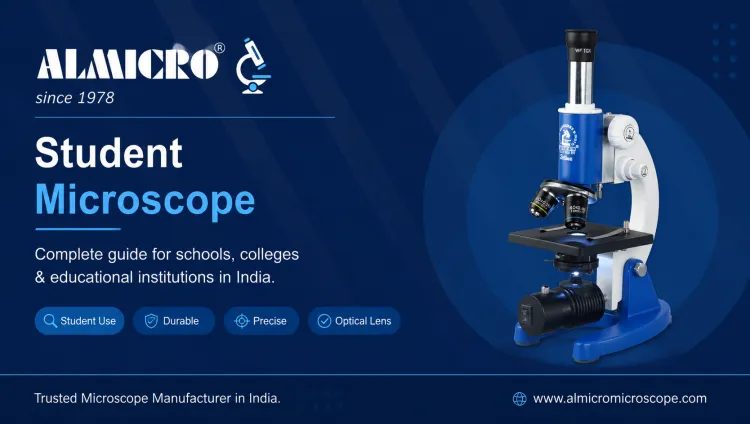
Student Microscope: Types, Diagram & Complete Guide
By ALMICRO | Student Microscope Manufacturer in India Since 1978
1. Introduction
A student microscope is a precision optical instrument designed specifically for educational use. It allows students to observe specimens at magnified levels that are not visible to the naked eye. From examining plant cells in a biology class to studying microorganisms in a laboratory practical, this instrument sits at the center of science education across every level.
In India, science education depends heavily on well-equipped laboratories. Schools and colleges that provide students with functional, reliable microscopes give them a direct advantage in understanding biological concepts. Hands-on learning through microscopy builds observational skills, analytical thinking, and a genuine interest in the sciences.
ALMICRO has been manufacturing optical and laboratory instruments from India since 1978. Over four decades of production experience, institutional supply, and quality engineering make ALMICRO one of the most trusted names in educational microscopy across the country. This article provides an in-depth reference for institutions, procurement officers, and educators evaluating microscope options for their laboratories.
2. What is a Student Microscope?
A student microscope is a compound optical instrument that uses two or more lenses to magnify specimens mounted on glass slides. It typically offers a magnification range of 40x to 400x, which covers the majority of educational observation requirements at the school and undergraduate level.
Unlike research-grade microscopes, which can cost several lakhs and offer magnification beyond 1000x along with phase contrast, fluorescence, or confocal imaging capabilities, the student microscope is built for durability, simplicity, and affordability. It does not compromise on optical quality but does eliminate features that are irrelevant at the classroom level. The focus is on function: clear imagery, ease of use, and resistance to the kind of handling that is common in student laboratories.
Research microscopes are calibrated for specialist use and require trained operators. Student microscopes are designed so that a learner with basic instruction can set up a slide, focus the lens, and make observations within minutes. That accessibility is precisely what makes them indispensable in educational institutions.
3. Student Microscope Diagram: Parts and Their Functions

Understanding a student diagram of a microscope is the first step in learning how to use one correctly. Each component has a specific role, and knowing the function of every part helps students operate the instrument with confidence and prevents accidental damage.
Eyepiece (Ocular Lens)
The eyepiece is the lens through which the observer looks. In most student microscopes, it carries a magnification of 10x. Some models offer a wider field of view eyepiece (WF10x or WF15x), which makes it easier for students to locate and observe specimens. The eyepiece magnification multiplies with the objective lens to give the total magnification.
Objective Lenses
Mounted on a rotating nosepiece, objective lenses come in three or four magnifications: 4x, 10x, 40x, and sometimes 100x (oil immersion). The student diagram clearly shows the nosepiece as the rotating disc that holds these lenses. Rotating to a higher objective lens increases magnification but reduces the field of view and requires precise focusing. Most student-level biology work is done using 10x and 40x objectives.
Stage
The stage is the flat platform on which the specimen slide is placed. In basic student microscopes, slides are held in place with metal stage clips. In higher-specification models, a mechanical stage allows the user to move the slide precisely using two knobs, one for lateral movement and one for longitudinal movement. A mechanical stage significantly improves the ease of scanning a specimen systematically.
Coarse and Fine Adjustment Knobs
These two knobs sit on the arm of the microscope and control the vertical movement of the stage or the tube. The coarse adjustment knob is larger and moves the stage rapidly, used for initial focusing. The fine adjustment knob is smaller and moves the stage in very small increments, used to bring the specimen into sharp focus once the coarse adjustment has brought it approximately into view. In a student diagram, these knobs are among the most prominently labeled parts.
Light Source
Older student microscopes used a mirror to reflect ambient or lamp light upward through the stage. Modern instruments use a built-in LED or halogen light source located at the base. LED illumination is preferred because it produces consistent, cool white light, consumes less power, and has a long operational life. Many models include an iris diaphragm or disc diaphragm below the stage that allows the user to control light intensity, which is important when working with different specimen thicknesses.
The student diagram of a microscope also typically identifies the arm (which is gripped when carrying the instrument), the base (the heavy lower section providing stability), the body tube (which holds the eyepiece), and the condenser (a lens system below the stage that focuses light onto the specimen). Understanding every part in the student diagram before using the instrument is recommended in every laboratory protocol.
4. Types of Student Microscopes
Different educational requirements call for different configurations. Institutions should understand what each type offers before making a purchase decision.
Monocular Student Microscope
A monocular student microscope has a single eyepiece. It is the most economical option and suitable for primary and secondary school laboratories. It is lightweight, compact, and easy for younger students to operate. The limitation is that one-eyed viewing can cause fatigue during extended observation sessions.
Binocular Student Microscope
A binocular student microscope has two eyepieces, allowing both eyes to be used simultaneously. This dramatically reduces eye strain and is recommended for senior secondary and undergraduate college laboratories. The binocular head also makes it easier to draw specimens, as students can look with one eye and sketch with the other. Binocular instruments are the preferred choice for college labs where students spend extended time on practicals.
Digital Student Microscope
A digital student microscope includes a built-in camera that connects to a computer, monitor, or tablet. It allows the entire class to view the same specimen on a screen simultaneously, making it ideal for demonstration purposes. Digital microscopes also enable image capture and documentation, which is useful for project work and assessments. Schools investing in smart classroom infrastructure increasingly prefer digital models.
Compound Student Microscope
The compound student microscope is the standard instrument used across Indian schools and colleges. It uses two sets of lenses, the eyepiece and the objective, to magnify specimens. The term 'compound' refers to this two-lens system. Most student microscopes in Indian educational laboratories are compound instruments. They are versatile, cover a broad range of magnifications, and are capable of observing cells, tissues, bacteria, fungi, and other biological specimens that are part of the standard curriculum.
Explore Types of Student Microscopes
5. Key Features of a High-Quality Student Microscope
When evaluating microscopes for institutional procurement, the following parameters directly affect performance, longevity, and value for money.
Magnification Range
A student microscope should offer at least 40x, 100x, and 400x magnification to cover all standard school and college practical requirements. Some models extend to 1000x with an oil immersion objective, which is useful for advanced microbiology practicals. Do not purchase a microscope that only offers low magnification; it will restrict the scope of laboratory work.
Optical Clarity
The quality of the glass used in the objective and eyepiece lenses determines image clarity. DIN-standard (Deutsche Industrie Norm) lenses, which are internationally compatible and interchangeable, provide reliable optical performance. Anti-reflection coatings on lenses reduce glare and improve contrast, which makes a measurable difference when observing stained specimens.
Build Quality and Frame Construction
Institutional microscopes take heavy use. The body must be made of die-cast metal, not plastic. A metal body holds calibration over time, resists physical shock, and does not degrade with exposure to laboratory chemicals. Instruments with plastic bodies might seem cost-effective initially but require replacement far sooner.
Illumination System
Built-in LED illumination is the current standard. It provides stable, consistent light, which is important for accurate observation. Models with adjustable brightness give students greater control over contrast. Halogen light sources are still acceptable but generate heat and require bulb replacement more frequently.
Durability for Classroom Use
Classrooms are not controlled environments. Instruments are moved, occasionally dropped, and used by students with varying levels of care. A microscope for educational use should have a sturdy stage, protected adjustment knobs, and a coaxial coarse-and-fine focus system that is difficult to damage through normal student handling. Rubber eyecups and safety rests add additional durability.
6. Applications in Education
The educational applications of the student microscope span across multiple levels of schooling and a wide range of scientific disciplines.
School Laboratories (Class 6 to 12)
School science labs introduce students to cell structure, plant and animal tissues, fungi, and protozoa. A standard compound student microscope at 100x to 400x magnification is sufficient for all CBSE and ICSE practical requirements at this level. Schools that equip their labs with functional instruments see better student engagement and improved practical examination results.
College and University Laboratories
Undergraduate biology, zoology, botany, microbiology, and biotechnology programs require higher optical performance and more frequent use. College laboratories need binocular student microscopes with mechanical stages, high-quality optics, and long service life. These institutions often require instruments that also support photographic documentation for research projects.
Biology Practical Examinations
Board-level practical examinations under CBSE, ICSE, and state boards require students to prepare slides and observe specimens independently. The student microscope is the primary tool in these examinations. Institutions must maintain instruments in proper working condition, with clean optics and functional adjustment mechanisms, to ensure fair assessment outcomes.
Medical and Paramedical Training
Nursing institutes, pharmacy colleges, and allied health training programs use student microscopes for histology, hematology, and microbiology practicals. Students in these programs need to identify blood cells, tissue samples, and microbial cultures. A reliable educational microscope with clear optics at 400x and above is essential for this category of institution.
7. How to Use a Student Microscope: Step-by-Step
Proper technique extends the life of the instrument and ensures accurate observations. The following procedure should be taught to students before independent laboratory sessions.
Step 1: Setup
Place the microscope on a flat, stable surface with the arm facing you. Carry it using both hands, one gripping the arm and one supporting the base. Connect the power supply if the instrument has built-in illumination. Rotate the nosepiece to the lowest magnification objective (4x or 10x) before starting. This is the safest position for placing slides.
Step 2: Slide Placement
Place the prepared glass slide on the stage and secure it with the stage clips or mechanical stage clamps. Ensure the specimen is centered over the stage aperture, which is the hole through which light passes. Turn on the light source and adjust brightness as needed.
Step 3: Initial Focusing
Look at the microscope from the side and use the coarse adjustment knob to bring the objective lens close to the slide, but without touching it. Then look through the eyepiece and use the coarse adjustment knob to move the stage downward (or the tube upward, depending on the model) until the specimen comes into rough focus.
Step 4: Fine Focus and Observation
Once the specimen is roughly visible, switch to the fine adjustment knob for precise focusing. To increase magnification, rotate the nosepiece to the next objective without changing the slide position. Re-focus using only the fine adjustment knob when switching to higher objectives. Look through the eyepiece with a relaxed eye, not squinting, to reduce fatigue.
8. Advantages of Using a Student Microscope in Educational Settings
Institutions often ask why a dedicated educational microscope is preferable to simply using lower-cost general instruments. The reasons are straightforward.
Designed for Ease of Use
Student microscopes are designed with simplicity in mind. The controls are intuitive, the labeling is clear, and the setup process takes minutes. This makes them appropriate for students who are encountering microscopy for the first time. Less time troubleshooting equipment means more time learning science.
Cost-Effective for Bulk Procurement
Schools and colleges need instruments in quantities of ten to fifty units or more. Student microscopes are priced appropriately for institutional procurement budgets without sacrificing functional quality. The cost-per-unit is manageable, and with proper care, a well-built instrument serves a laboratory for fifteen to twenty years.
Appropriate for Beginner to Intermediate Use
From a Class 6 student observing an onion cell for the first time to a second-year biology undergraduate examining histological sections, the student microscope serves every level within that spectrum. There is no need to purchase different instruments for different year groups when a well-specified student microscope covers the full range of educational applications.
9. Buying Guide: What Institutions Should Know Before Purchasing
Procurement decisions for laboratory instruments should be driven by technical specifications and institutional requirements, not price alone. The following points serve as a practical checklist.
Assess Your Curriculum Requirements
Before purchasing, review the syllabus for all classes that will use the laboratory. If the curriculum includes microbiology or histology, you will need instruments with at least 400x magnification and a mechanical stage. If the lab serves only junior school students, a basic monocular compound microscope at 100x to 400x is sufficient.
Check Optical Standards
Insist on DIN-standard optics. Instruments using DIN objectives and eyepieces ensure interoperability, meaning replacement lenses from any DIN-compliant manufacturer will fit. This significantly reduces long-term maintenance costs. Ask the manufacturer to confirm whether their lenses meet DIN standards before confirming an order.
Verify Build Material
Request a product specification sheet and confirm the body is die-cast metal or alloy. Plastic-bodied instruments are not suitable for institutional lab use. Verify that the stage, arm, and base are all metal construction.
Common Mistakes to Avoid
Purchasing based on price alone without checking optical specifications is the most common error. Other mistakes include buying instruments without after-sales service availability, ignoring whether spare parts (bulbs, objectives, eyepieces) are locally available, and selecting monocular instruments for college labs where binocular models are clearly more appropriate. Always request a demonstration unit before placing a bulk order.
Recommended Specifications for School Labs
- Eyepiece: WF10x wide-field
- Objectives: 4x, 10x, 40x (DIN standard)
- Total magnification: 40x to 400x
- Illumination: Built-in LED with adjustable brightness
- Stage: Fixed with spring clips (mechanical stage for college level)
- Body: Die-cast metal frame
- Focus: Coaxial coarse and fine adjustment
10. Why Choose ALMICRO as Your Student Microscope Manufacturer in India
Selecting a manufacturer is as important as selecting the instrument. The after-sales relationship, availability of spares, and reliability of supply define your long-term experience. ALMICRO has been a trusted student microscope manufacturer in India since 1978, and that longevity is not incidental.
Four Decades of Manufacturing Experience
Since 1978, ALMICRO has supplied educational microscopes to schools, colleges, medical institutes, and research organizations across India. This depth of experience translates into instruments that are designed around actual Indian classroom conditions, not adapted from overseas specifications. The design considers voltage fluctuations, humidity, and the specific practical requirements of Indian curricula.
Indian Manufacturing, Indian Pricing
As a student microscope manufacturer in India, ALMICRO produces instruments domestically, which keeps costs competitive without compromising quality. Institutions benefit from import-free pricing, faster delivery timelines, and local availability of replacement parts. This is particularly important for government schools and colleges operating under strict procurement budgets.
Trusted by Educational Institutions Nationwide
ALMICRO instruments are in active use in thousands of laboratories across India. The trust of educational institutions, from CBSE-affiliated schools to state university colleges, has been built through consistent quality and responsive service. When a bulk order is placed, ALMICRO ensures all instruments in that batch meet uniform quality standards, not just sample units.
Quality Assurance and After-Sales Support
Every student microscope from ALMICRO goes through optical and mechanical inspection before dispatch. As a manufacturer, ALMICRO maintains direct control over production quality, unlike distributors who resell instruments from multiple sources. After-sales service, spare parts availability, and technical support are provided directly, ensuring institutions are not left without support after purchase.
For distributors, ALMICRO offers structured supply arrangements with consistent product quality and competitive trade pricing. As a student microscope manufacturer in India with a long export and domestic supply track record, ALMICRO supports distributors with product documentation, demonstration units, and technical training.
11. Maintenance and Care Tips for Student Microscopes
A student microscope that is maintained correctly will remain in service for fifteen to twenty years. Laboratory supervisors and teachers should implement the following care protocols.
Cleaning the Lenses
Use only lens tissue or a clean, soft optical cloth to wipe lenses. Never use paper towels, tissue paper, or clothing, as these materials contain abrasive fibers that scratch optical coatings. Apply lens cleaning solution sparingly and in circular motions. Clean the eyepiece and objectives after every practical session, especially if oil immersion objectives have been used.
Storage
Store microscopes in their protective covers or cases when not in use. Keep them in a dry, dust-free cupboard. Fungal growth on lens surfaces is a common problem in humid Indian climates. Silica gel sachets placed inside storage cupboards help maintain low humidity. Lenses that are stored without covers in humid conditions will develop fungal contamination within months, which permanently reduces optical quality.
Handling in the Lab
Establish clear protocols for carrying, placing, and using instruments. Students should always carry microscopes with both hands, one holding the arm and one supporting the base. Slides should never be forced under stage clips, and the coarse adjustment knob should never be used to press the objective into the slide. A brief orientation session before the first practical reduces damage significantly.
Periodic Servicing
Arrange for annual or biannual servicing of all laboratory microscopes. This includes cleaning internal optics, lubricating mechanical components, checking electrical connections, and replacing any worn parts. ALMICRO provides servicing support for its instruments and can supply replacement objectives, eyepieces, and light sources as required.
12. Frequently Asked Questions
Q1. What is a student microscope, and how is it different from a regular microscope?
A student microscope is a compound optical instrument built for educational use. It offers magnifications from 40x to 400x and is designed to be durable, easy to operate, and affordable. A research microscope offers higher magnification, advanced optical modes such as phase contrast or fluorescence, and is built for precision laboratory investigation by trained professionals. Student microscopes prioritize accessibility and robustness over advanced functionality.
Q2. What magnification is appropriate for school and college students?
For school-level biology, 100x to 400x is sufficient for observing plant and animal cells, tissues, and microorganisms covered in the curriculum. At the undergraduate college level, access to 400x to 1000x (with oil immersion) allows students to work with bacteria and detailed cellular structures. Ensure the instrument you purchase covers at least 40x, 100x, and 400x for comprehensive curriculum coverage.
Q3. What is shown in a student diagram of a microscope?
A standard student diagram labels all major parts: eyepiece, body tube, nosepiece, objective lenses, arm, stage with clips, aperture, coarse and fine adjustment knobs, condenser, diaphragm, light source, and base. This student diagram is a required element in biology textbooks at all levels and is commonly tested in practical examinations.
Q4. How many microscopes should a school laboratory have?
The standard recommendation is one microscope per student pair. For a class of thirty students, fifteen instruments are the minimum. Schools with larger classes should have a minimum of twenty instruments to ensure all students can participate in practicals simultaneously. A surplus of two to three instruments accommodates units that may be under maintenance.
Q5. Is a monocular or binocular student microscope better for colleges?
Binocular models are clearly preferable for college laboratories. Students spend extended periods observing specimens during practical sessions, and binocular viewing significantly reduces eye strain. The additional cost per unit is justified by the improved comfort and usability, particularly in programs like botany, zoology, microbiology, and medical laboratory technology.
Q6. What is the expected lifespan of a student microscope?
A well-maintained metal-body student microscope with quality optics should last fifteen to twenty years in an educational setting. The key factors are lens cleaning discipline, proper storage in dry conditions, and periodic mechanical servicing. Plastic-body instruments have a significantly shorter lifespan under institutional use conditions.
Q7. Can I get customized student microscopes for bulk institutional orders?
Yes. ALMICRO, as a manufacturer, can accommodate specific configuration requirements for bulk institutional orders. This includes specific objective combinations, engraved institutional labeling, custom packaging, and optional accessories such as mechanical stages, carrying cases, or digital camera attachments. Procurement officers should discuss specific requirements directly with the ALMICRO sales team.
13. Conclusion
The student microscope is not a peripheral laboratory tool. It is a foundational instrument that defines the quality of science education in schools and colleges. Institutions that equip their laboratories with well-built, optically reliable microscopes give students a genuine learning advantage. From understanding the student diagram during initial lessons to conducting independent practicals in advanced college programs, this instrument remains central to the biological sciences curriculum.
Procurement decisions should prioritize optical quality, build material, magnification range, and long-term service support over initial purchase price. A cheaper instrument that fails within three years is more expensive in the long run than a quality instrument that serves two decades of students.
ALMICRO brings over four decades of manufacturing experience to every instrument it produces. As a dedicated student microscope manufacturer in India, ALMICRO understands the specific demands of Indian educational institutions and has built its product range accordingly. Whether you are equipping a new school laboratory, upgrading an existing college lab, or building a supply chain as a distributor, ALMICRO offers the quality, consistency, and support that institutional procurement demands.
Contact ALMICRO for product catalogs, pricing, and bulk order discussions. Build laboratories that students remember, and instruments that outlast the curriculum.
ALMICRO | Student Microscope Manufacturer in India Since 1978
Related Article
2. What is Compound Microscope?
5. Who is the Best Microscope Manufacturer in India?