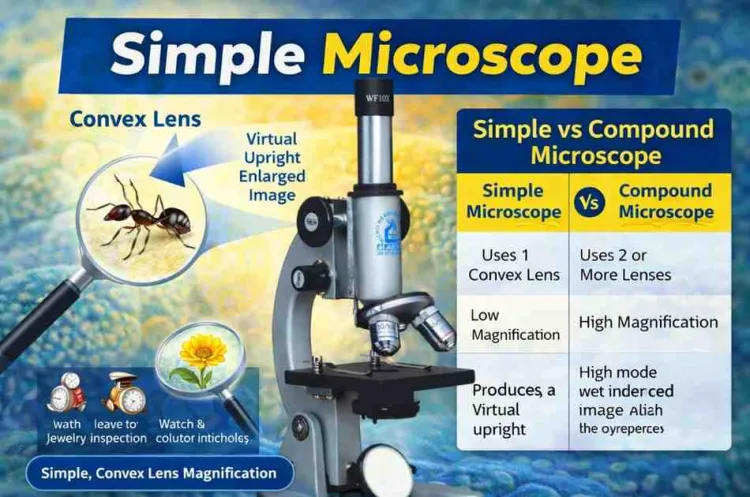
A simple microscope is a basic optical device that uses a single convex lens to magnify small objects. When the object is placed close to the lens, it forms a virtual, upright, and enlarged image. A magnifying glass is the most common example of a simple microscope.

Simple Microscope Diagram

Magnified View of Objects Using a Simple Microscope
Principle of Simple Microscope
A simple microscope works on the principle of magnification by a convex lens. The main idea is that a convex lens bends (refracts) light rays coming from an object to make it appear larger than it really is.
-
Convex Lens: The microscope has a single convex lens, which is thicker in the middle and thinner at the edges.
-
Object Placement: The object to be observed is placed closer to the lens than its focal length.
-
Virtual Image Formation: When light rays from the object pass through the lens, they diverge. The eye perceives these diverging rays as coming from a larger, upright virtual image.
-
Magnification: The image appears bigger than the actual object because the lens increases the angle under which the eye sees the object, making fine details visible.
-
Upright Image: Unlike compound microscopes, a simple microscope always produces an upright image, making it easy to observe.
Key Idea:
The simple microscope magnifies small objects using one convex lens, forming an upright and virtual image when the object is placed within the focal length of the lens.
Example: A magnifying glass is a practical example of a simple microscope. It is widely used by students, jewelers, and hobbyists to observe tiny details clearly.
Difference Between a Simple Microscope and a Compound Microscope
| Feature | Simple Microscope | Compound Microscope |
|---|---|---|
| Lens System | Uses a single convex lens to magnify objects. | Uses two or more lenses – an objective lens and an eyepiece for higher magnification. |
| Magnification Power | Low magnification, usually up to 10x–20x. | High magnification, can range from 40x to 1000x or more. |
| Image Type | Produces a virtual, upright image. | Produces a real, inverted image which is then magnified by the eyepiece into a virtual image. |
| Complexity | Simple and easy to use, requires no special skills. | Complex in design, needs careful focusing and handling. |
| Size and Portability | Small, hand-held, and portable (like a magnifying glass). | Large, table-top instrument, not easily portable. |
| Usage | Used for basic observation: reading small text, examining insects, jewelry, etc. | Used for scientific and laboratory purposes, like studying cells, bacteria, and tissues. |
| Cost | Low cost, affordable for everyone. | Expensive, more suitable for labs and research. |
Simple Uses of a Microscope
-
To observe cells and microorganisms not visible to the naked eye
-
To study plant and animal tissues
-
To examine bacteria and fungi in laboratories
-
To analyze blood samples and medical specimens
-
To identify disease-causing organisms
-
To inspect tiny parts and materials in research and industry
-
To support scientific experiments and education
-
To observe slides in biology and pathology labs
Parts of a Simple Microscope

A simple microscope is a basic optical instrument, and it consists of the following main parts:
Convex Lens (Magnifying Lens):
-
The most important part of a simple microscope.
-
It is a single lens that magnifies the object.
-
Light rays from the object pass through this lens to form a virtual, enlarged image.
Lens Holder:
-
Holds the convex lens securely in position.
-
Ensures the lens stays steady for clear observation.
Focusing Knob:
-
Allows adjusting the distance between the lens and the object.
-
Helps in getting a sharp and clear image of the specimen.
Stage (Object Platform):
-
The flat platform where the object or specimen is placed.
-
Often has clips to hold the slide in place.
Clips:
-
Small clamps on the stage that hold the slide so it does not move during observation.
Mirror or Light Source:
-
Reflects light onto the object to illuminate it properly.
-
Some simple microscopes use built-in LED lights instead of a mirror.
Base:
-
The bottom part that supports the microscope and provides stability.
Summary:
Each part of a simple microscope works together to magnify small objects, making it easier to see fine details. The convex lens enlarges the object, while the stage, clips, and light source help in holding and illuminating the specimen.
Magnification of a Simple Microscope
A simple microscope magnifies small objects so they can be seen clearly. Its magnification power depends on the convex lens and is calculated using the formula:
M=1+D/f
Where:
-
M = Magnification power of the simple microscope
-
D = Least distance of distinct vision (for a normal human eye, D = 25 cm)
-
f = Focal length of the convex lens
Explanation:
-
The formula shows that the magnification increases as the focal length decreases.
-
This means, a lens with a shorter focal length produces a larger and clearer image of the object.
-
Simple microscopes generally have low to moderate magnification, suitable for observing tiny objects like insects, leaves, or small texts.
Key Point:
To get a higher magnification, use a lens with a smaller focal length, keeping the object within the focal distance of the lens.
Simple Microscope Experiments You Can do
A simple microscope is not only easy to use but also great for performing fun and educational experiments. Here are some simple experiments you can try:
Observe Small Insects:
-
Place an insect like an ant or fruit fly on the stage.
-
Look closely at its body parts, legs, and antennae using the convex lens.
Examine Plant Leaves:
-
Take a fresh leaf and observe its veins, texture, and tiny structures.
-
You can compare leaves from different plants to study patterns.
Study Textile Fibers:
-
Place threads or fabric on the stage.
-
Notice the weaving patterns and fiber details that are invisible to the naked eye.
Look at Sand and Soil Particles:
-
Place a small amount of sand, soil, or sugar crystals under the microscope.
-
Observe their shapes, sizes, and textures.
Observe Printed Text:
-
Examine printed text from newspapers or books.
-
You can see the tiny dots and letters that are not visible to the naked eye.
Inspect Jewelry or Coins:
-
Use the microscope to check fine details on jewelry, coins, or stamps.
-
This helps understand craftsmanship and authenticity.
Compare Different Specimens:
-
Try observing different types of leaves, insects, or fabric side by side.
-
Note differences in structure, color, and pattern.
Tips for Experiments:
-
Always use good lighting to see clear details.
-
Keep the object steady on the stage using clips if available.
-
Start with low magnification and move closer for better details.
Frequently Asked Questions (FAQs)
1. What is a simple microscope?
A simple microscope is a basic optical instrument that uses a single convex lens to magnify small objects, producing a virtual and upright image.
2. Which lens is used in a simple microscope?
A simple microscope uses only one convex lens, which bends light rays to enlarge the appearance of an object placed close to the lens.
3. Why is a magnifying glass called a simple microscope?
A magnifying glass works on the same principle as a simple microscope by using a single convex lens to magnify objects, making it the most common example.
4. What type of image is formed by a simple microscope?
A simple microscope forms a virtual, upright, and enlarged image, which makes observation easy and comfortable for the human eye.
5. What is the magnification power of a simple microscope?
The magnification power of a simple microscope is usually low, typically ranging from 10× to 20×, depending on the focal length of the convex lens.
6. How does a simple microscope work?
A simple microscope works by placing an object within the focal length of a convex lens. The lens refracts light rays and forms a magnified virtual image.
7. What are the main parts of a simple microscope?
The main parts of a simple microscope include a convex lens, lens holder, focusing knob, stage, clips, mirror or light source, and base.
8. Where is a simple microscope commonly used?
Simple microscopes are widely used in schools, basic laboratories, watch repair, jewelry inspection, textile examination, and reading small print.
9. Why is a simple microscope easy to use?
A simple microscope is easy to use because it has a single lens system, does not require complex focusing, and is lightweight and portable.
10. What is the principle of a simple microscope?
The principle of a simple microscope is magnification by a convex lens, where the object placed within the focal length appears larger and upright.
11. How is a simple microscope different from a compound microscope?
A simple microscope uses one lens with low magnification, while a compound microscope uses multiple lenses and provides high magnification for detailed study.
12. Can a simple microscope be used to study cells?
No, a simple microscope has limited magnification and is not suitable for studying cells or bacteria. For that, a compound microscope is required.
13. Why does focal length matter in a simple microscope?
A shorter focal length of the convex lens provides higher magnification, making smaller details more visible in a simple microscope.
14. Is a simple microscope portable?
Yes, a simple microscope is small, lightweight, and portable, which makes it ideal for quick observations and field use.
15. What are some experiments that can be done using a simple microscope?
Using a simple microscope, one can observe insects, plant leaves, textile fibers, soil particles, printed text, jewelry details, and coins.