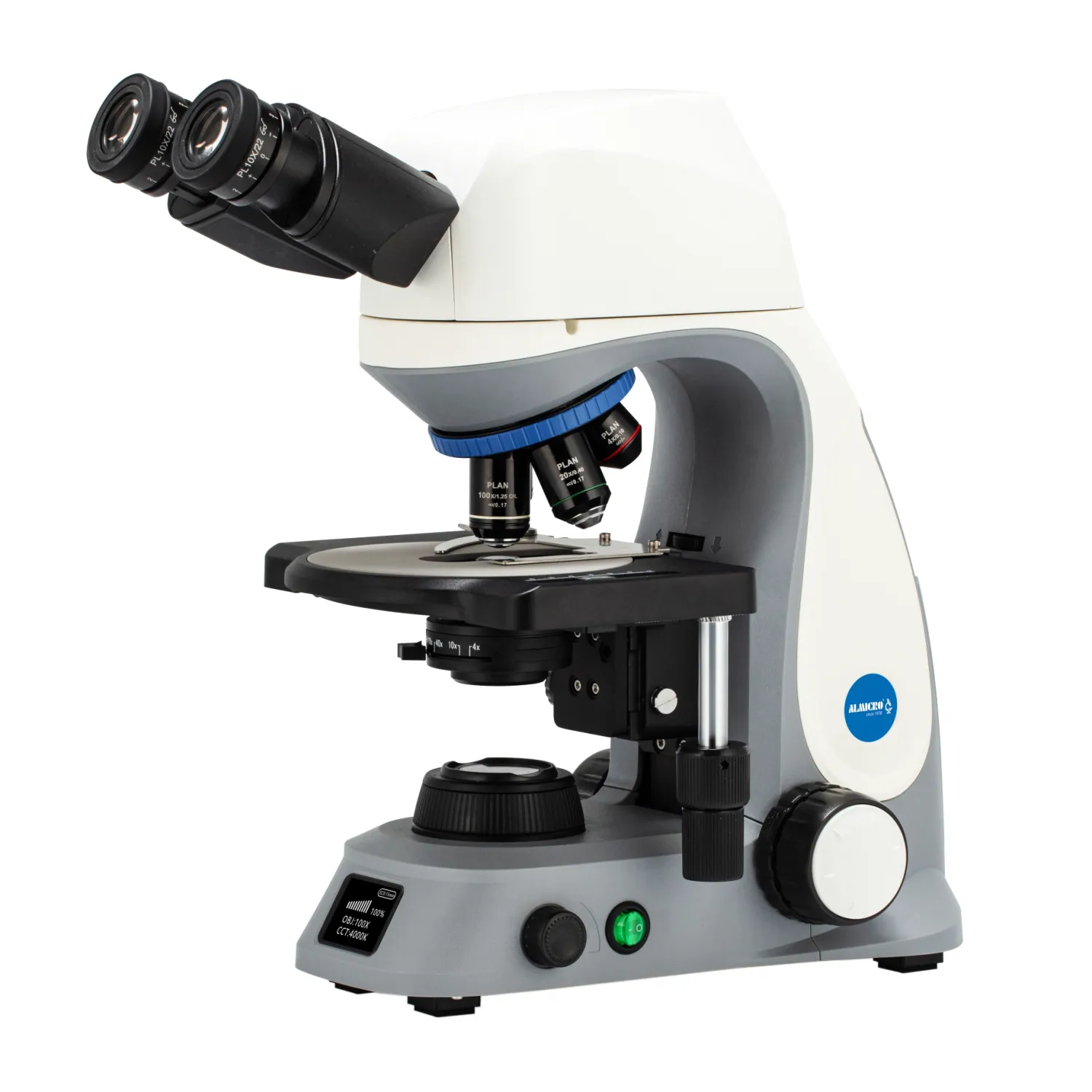

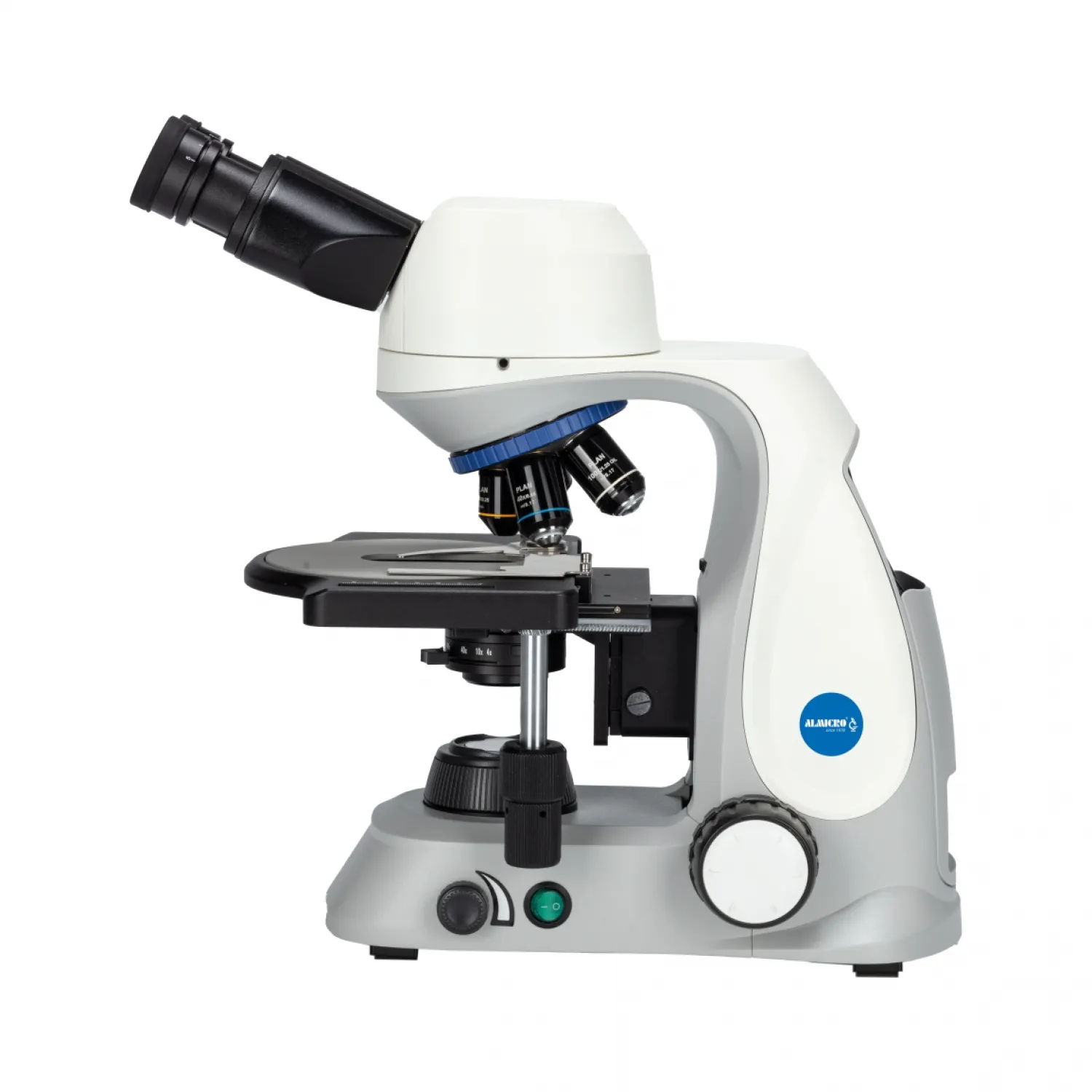
Advance Research Microscope (EXL)
This Advanced Research Microscope EXL by ALMICRO is a high-quality, research-grade optical microscope built for labs and scientific work. It offers sharp, high-magnification imaging, precise optics, and a robust illumination system — making it suitable for biological, histological, industrial, and research applications where clarity and reliability matter.
Advance Research Microscope (EXL)
Advance Research Microscope EXL Specification Table
| Specification | Details |
|---|---|
| Optical System | Infinity corrected optical system |
| Observation Tube | Binocular or trinocular head, 45 degree inclination, interpupillary distance 48 to 75 mm |
| Eyepieces | Paired 10x widefield eyepieces with diopter adjustment, lockable |
| Objectives | 4x NA 0.10, 10x NA 0.25, 40x spring NA 0.65, 100x oil spring NA 1.25 |
| Viewing Head | Binocular head with upgrade option to trinocular |
| Nosepiece | Quadruple nosepiece |
| Focusing System | Coaxial coarse and fine focus, torque adjustment, upper limit stopper |
| Stage | Mechanical stage, about 170 x 90 mm, travel about 75 x 30 mm |
| Condenser | Abbe condenser with iris |
| Light Source | 3 W LED with brightness control |
| Power Supply | AC adaptor 110 to 240 V |
| Battery Backup | Optional rechargeable battery |
| Packaging | Thermocol inner support with cardboard outer box |
Working Principle
The EXL operates as a compound light microscope: it uses a set of glass lenses (objective lenses + eyepiece) to magnify small specimens. Light from the built-in LED illuminator passes through (or reflects off) the specimen, then through the objective lens to form a primary enlarged image; the eyepiece further magnifies this to allow detailed observation.As light travels through different media (air → glass → specimen), it refracts (bends), enabling the lenses to focus and enlarge the image of minute structures. The resolution (smallest distinguishable detail) depends on the numerical aperture of the lenses and the wavelength of light used.
In other words: by combining multiple lenses and precise illumination, the microscope magnifies and reveals details of tiny specimens (cells, tissues, micro-structures) that are invisible to the naked eye.